Circular Products – Ecodesign and Digital Product Passports (2025–2028)
A national flagship project developing ecodesign methods and digital product passports to support circular product development, repair, reuse, and take-back systems in Danish manufacturing industries. The project focuses on supporting the circular transition of Danish SMEs through practical ecodesign approaches, lifecycle thinking, and implementation of digital product passports in real-world industrial contexts.
Partners: FORCE Technology (lead), Aarhus University, University of Southern Denmark, and approximately 30 Danish SMEs engaged through project activities.
Funding: Industriens Fond.
EU LIFE FIBRA – Circular Integration of Novel Natural Fibre-Based Feedstocks into Forest-Based Value Chains (2026–2029)
An international EU LIFE project exploring how novel natural fibre-based feedstocks can be integrated into circular industrial systems and forest-based value chains. At IDE, the project focuses on sustainable product design, socio-technical systems, recyclability, and sustainability implications of scaling new fibre systems. The work builds on IDE’s expertise in circular design, lifecycle thinking, ecodesign, fibre substitution, and system-level implementation pathways.
Partners: Danish Council for Sustainable Forestry (Coordinator), FSC International Center GmbH, FSC Global Development GmbH, Gutes Holz Service GmbH, Stichting Goed Hout & Goed Papier!, Föreningen Skogen i Centrum, Conseil de Soutien de la Forêt (FSC France), Vastuullisen Metsänhoidon Yhdistys, Gestione Forestale Responsabile Servizi Società A, Stichting Circle Economy, Aarhus University, University of Southern Denmark, Environmental Coalition on Standards (ECOS), and the World Business Council for Sustainable Development (WBCSD).
Funding: European Union LIFE Programme.
Change4Circularity (2024–2027)
A national citizen science project investigating plastic pollution, household sorting, and textile and plastic waste management in Denmark. Through collaboration with schools, municipalities, NGOs, and research partners, the project generates one of Denmark’s largest datasets on circular behaviours and waste practices to support evidence-based transition strategies and circular literacy.
Partners: Roskilde University, The Royal Danish Academy, Astra, Green Transition Denmark, Plastic Change, The Danish Society for Nature Conservation, Brancheforeningen Cirkulær, schools, municipalities, and University of Southern Denmark.
Funding: Innovation Fund Denmark (TraCE – Transition to a Circular Economy).
READY – R&D Local Factory on Sustainable Textiles, Apparel and Furniture (2023–2026)
READY develops solutions for textile-to-textile recycling, local and bio-based fibres, and circular business models for the textile and furniture sectors. At IDE, the project focuses on circular business models, socio-technical implementation pathways, material-driven design, and the transition from material innovation to scalable circular systems.
Partners: VIA University College (lead), BESTSELLER, Kvadrat, The Royal Danish Academy, Danish Technological Institute, Nybo Workwear, Kjellerup Væveri, Sontex, Hack Recycling, Design and Lifestyle Cluster, and University of Southern Denmark.
Funding: Innovation Fund Denmark (Grand Solutions).
Design4Disassembly (2022–2024)
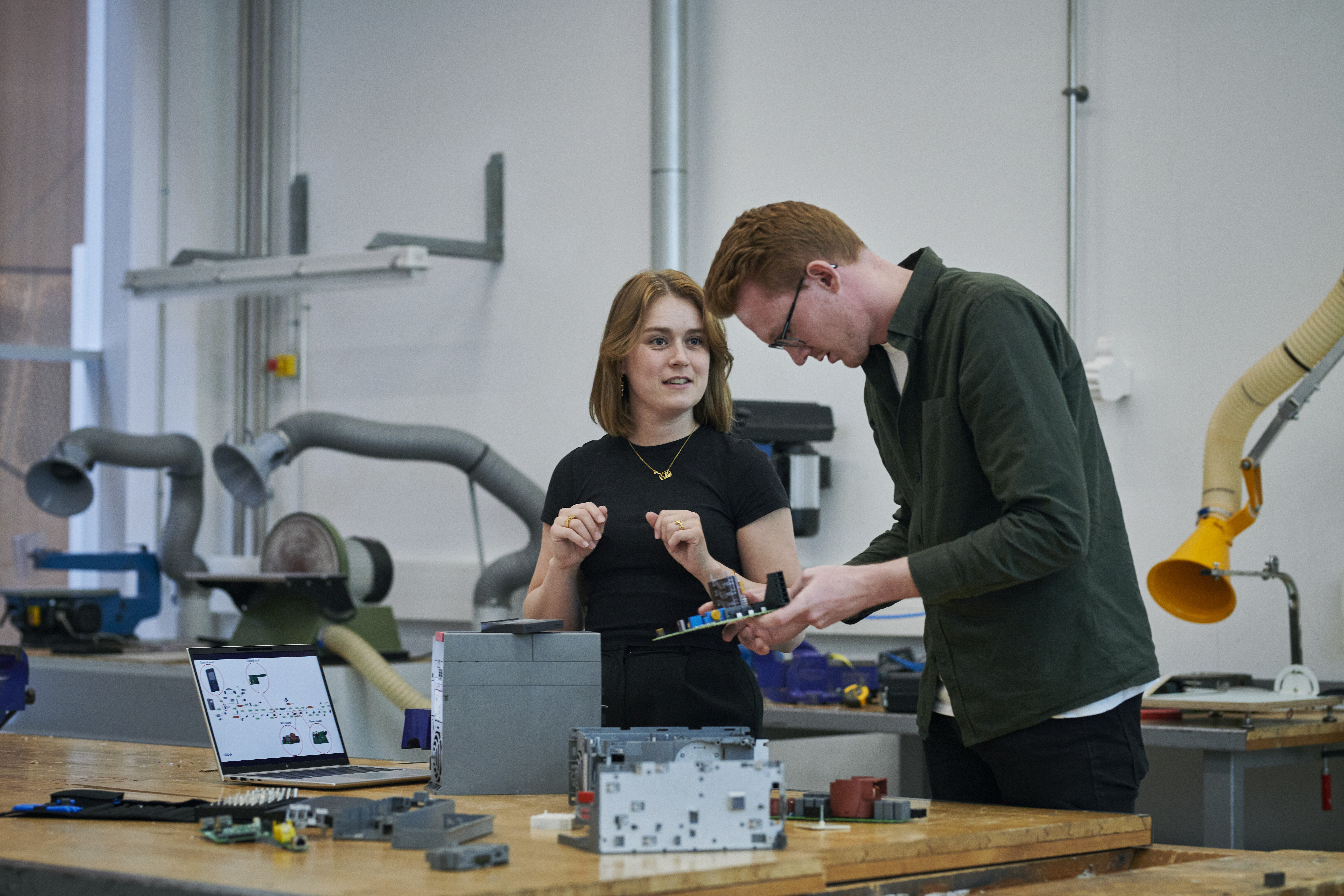
A research and industry collaboration project focused on designing products for easier disassembly, repair, reuse, and recycling. The project developed methods and tools supporting circular product architectures and robotic disassembly, helping companies transition towards more circular product systems.
Partners: LEGO Group, Danfoss Drives, Grundfos Holding, SDU Robotics, and University of Southern Denmark.
Funding: Innovation Fund Denmark (Innomission 4 / TraCE – Transition to a Circular Economy).
MADE REACT – Smart Manufacturing for Circular Product Disassembly (2025–2028)
Part of the MADE cluster, MADE REACT develops next-generation smart manufacturing solutions for more flexible and resilient production systems. At IDE, the project focuses on a PhD scholarship investigating design for ramp-up and ramp-down flexible robotic systems, exploring how transitions between manual and robotic assembly and disassembly can be optimised in production environments. The research examines how product and system design can support more adaptive manufacturing setups, enabling flexibility in circular production, repair, reuse, remanufacturing, and disassembly processes.
Partners: Led by the MADE Cluster in collaboration with Danish industry and research institutions. IDE contributes in Workstream 2, led by SDU Robotics, in close collaboration between SDU Innovation & Design Engineering and SDU Robotics.
Funding: Innovation Fund Denmark (Grand Solutions / MADE Cluster).
MADE FAST – Circular Manufacturing and Energy Optimisation with LEGO Group (2024–2025)
Research collaboration focused on reducing environmental impact in mould manufacturing and injection moulding. The project developed early-stage decision support tools for CO₂ reduction, energy optimisation, mould reuse, and circular manufacturing strategies in industrial production.
Partners: LEGO Group and University of Southern Denmark.
Funding: Innovation Fund Denmark and co-financed by the LEGO Group.
Circular Economy and Wind Turbine Blades – Initiative 115 (2022–2023)
Commissioned advisory work mapping waste streams and recycling opportunities for wind turbine blades in Denmark. The project contributed to national policy discussions on circular economy pathways for composite materials and renewable energy infrastructure, supporting evidence-based decision-making on end-of-life strategies for wind turbine blades.
Partners: Danish Environmental Protection Agency (EPA), Ministry of Environment, industry stakeholders, and University of Southern Denmark.
Funding: Commissioned advisory work by the Danish Environmental Protection Agency/Ministry of Environment.
IEA Wind Task 45 – Circular Economy for Wind Energy
IDE contributes to international policy development under the International Energy Agency’s Wind Technology Collaboration Programme, focusing on circular economy strategies, policy harmonisation, recycling pathways, and end-of-life solutions for wind turbine materials and components.
Partners: International Energy Agency Wind TCP Task 45, WindEurope, national research institutions, policymakers, and international stakeholders across the wind energy sector.
Funding: EUDP – programme for the Danish partners – part of the International Energy Agency Wind Technology Collaboration Programme (IEA Wind).