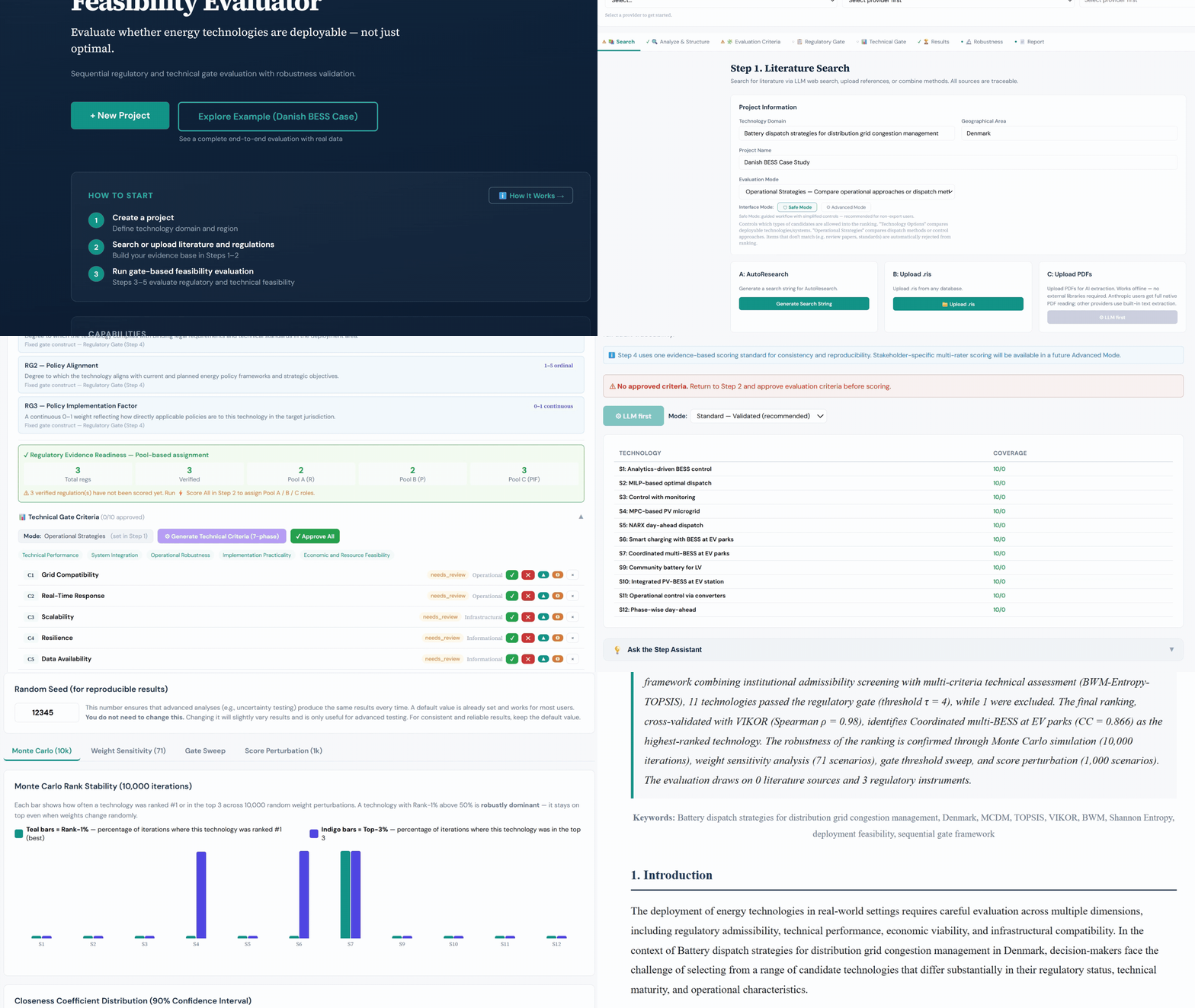
The Feasibility Evaluator Tool is a web-based decision-support platform designed to assess the deployment feasibility of energy solutions in real-world regulatory, policy, and technical contexts. It helps users evaluate whether a technology, operational strategy, or decision framework is not only technically promising, but also institutionally admissible and practically deployable.
The tool supports researchers, planners, policymakers, consultants, and energy-system stakeholders in conducting structured, evidence-based feasibility evaluations. It combines literature and regulation search, evidence extraction, regulatory screening, technical multi-criteria ranking, robustness analysis, and scientific report generation in one guided workflow. The underlying method follows a sequential gate logic, where policy and regulatory admissibility are assessed before technical ranking is performed.
Key features of the Feasibility Evaluator Tool:
- Web-Based and Guided Workflow: Feasibility Evaluator runs directly in a modern web browser and guides users through the full evaluation process, from project definition and evidence collection to regulatory screening, technical ranking, robustness analysis, and report generation.
- Evidence-Centric Evaluation: The tool is designed around traceable evidence. Literature sources, regulatory documents, standards, technical reports, and policy documents can be uploaded, searched, extracted, structured, and linked to scoring decisions. This ensures that evaluation outcomes are grounded in verifiable sources rather than opaque assumptions.
- Sequential Regulatory and Technical Gate: A distinctive feature of the tool is its two-layer evaluation architecture. The first layer assesses institutional admissibility through regulatory readiness, policy alignment, and policy implementation likelihood. Only solutions that pass this gate proceed to the second layer, where technical feasibility is evaluated. This prevents technically strong but legally or institutionally infeasible solutions from being recommended.
- Multi-Mode Evaluation: The tool supports different types of evaluation objects, including technology options, operational strategies, and decision frameworks. This makes it suitable for comparing deployable technologies, control and dispatch strategies, planning methods, or broader decision-support frameworks within a consistent structure.
- BWM–Entropy–TOPSIS Ranking: For technical evaluation, Feasibility Evaluator uses a hybrid multi-criteria decision-making method. Best-Worst Method captures expert-informed criterion importance, Shannon Entropy reflects data-driven differentiation, and TOPSIS ranks admissible solutions based on their closeness to the ideal solution. VIKOR is used as a cross-validation method to test whether the ranking is methodologically consistent.
- Robustness and Sensitivity Analysis: The tool includes Monte Carlo simulation, weight sensitivity analysis, gate-threshold sensitivity, score perturbation, and TOPSIS–VIKOR comparison. These functions help users understand whether the final ranking is stable or sensitive to changes in assumptions.
- Human-AI Supported Workflow: Feasibility Evaluator includes AI-assisted functions for literature search, PDF extraction, regulation structuring, criteria generation, scoring support, and step-by-step guidance. Human validation remains central: users can review, approve, revise, or override AI-generated outputs, and these interventions remain visible in the workflow.
- Scientific Report Generation: The tool can generate a structured scientific report including the project scope, evidence base, regulatory screening results, technical criteria, weighting method, decision matrix, ranking results, robustness analysis, discussion, conclusions, configuration appendix, and reference list. Reports can be exported as HTML and printed to PDF.
Theories Behind the Feasibility Evaluator Tool:
Feasibility Evaluator is grounded in deployment feasibility theory, multi-criteria decision-making, evidence-based decision support, and human-AI evaluation. The tool treats deployment feasibility as a layered construct: regulatory and policy conditions define whether a solution can enter the feasible option space, while technical performance differentiates among the solutions that are already admissible.
This logic differs from conventional flat scoring approaches, where regulatory weakness can be offset by strong technical performance. In Feasibility Evaluator, institutional admissibility acts as a prerequisite rather than an ordinary compensatory criterion.
How Feasibility Evaluator Advances the State of the Art:
Feasibility Evaluator advances existing energy decision-support tools in three main ways. First, it separates regulatory admissibility from technical performance ranking, making the evaluation logic closer to real deployment decisions. Second, it embeds evidence traceability, validation, confidence indicators, and reproducibility controls throughout the workflow. Third, it combines AI-assisted evidence processing with human validation, enabling scalable but reviewable feasibility assessment.
The tool therefore supports transparent, auditable, and policy-aware evaluation of energy solutions in regulated environments.
Principal Investigator and Developer: Zheng Grace Ma
Tool link: https://opportunityidentifier.sdu.dk/feasibilityevaluator/