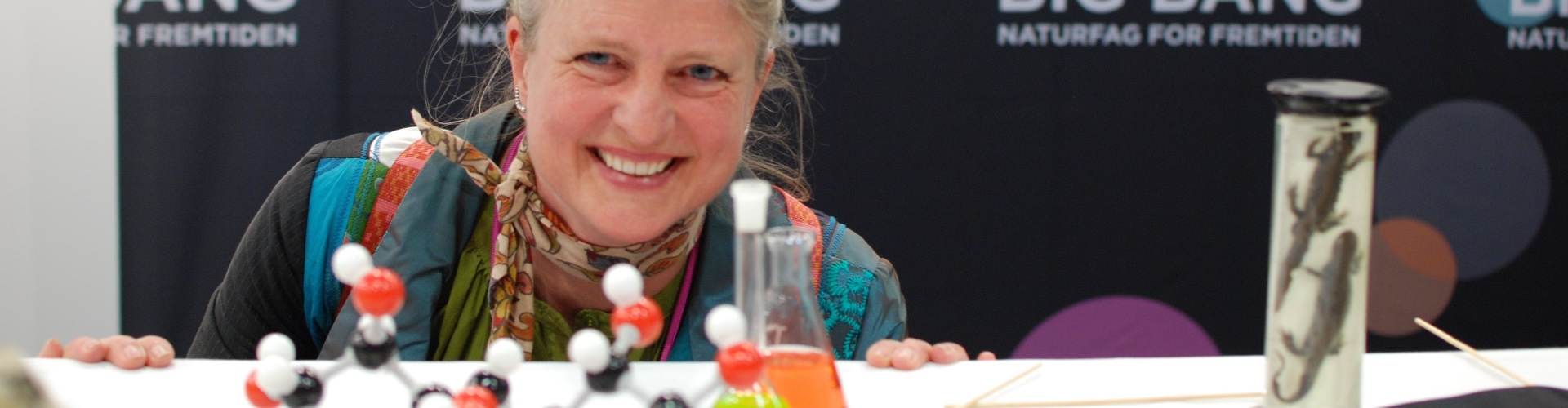
FNUG researchers at the Big Bang conference
Big Bang, Denmark’s largest science education conference and exhibition, takes place on March 18–19, 2026, at the Odense Congress Center, and researchers from FNUG are participating with presentations and workshops.
As tradition has it, a large group of researchers from FNUG head to the Big Bang Conference in March—both to actively contribute to panel debates, presentations, and workshops, and to gain new insights from colleagues from across the country. Below, you can read which FNUG researchers you can meet and what they contribute.
Wednesday, March 18
| 13:00-13:45 |
Therese Malene Nielsen, FNUG, SDU Time as a teacher: Learn more about slow learning Hear about the first experiences with the ‘slow movement’ in science education and find calm in slower learning processes. The presentation is based on the PhD project ‘slow science’, which explores how time influences teachers’ planning and delivery of teaching. |
| 13:00 - 13:45 |
Karina Kiær og Thomas R.S. Albrechtsen, UC Syd, Ole Kronvald og Thomas Sandholm Hald, Astra. Lesson study as a lever for science guidance in primary and lower secondary school You will get concrete examples of how science advisors collaborate across schools to develop teaching and strengthen teachers’ professional learning. You will gain ideas and methods that you can take directly back to your own guidance practice. |
| 14:00-14:45 |
Johan Kørvel Sørensen, FNUG, SDU How simulations give teachers a better understanding of frustrated students Simulations can give teachers insight into academic frustrations they have never experienced themselves. Johan Kørvel Sørensen talks about such a simulation, developed by four engineering graduates specializing in learning technology. |
| 14:00-14:45 |
Katrine Bergkvist Borch og Maiken Westen Holm Svendsen, FNUG, SDU Thinking, feeling, and doing – STEM didactics in a performative paradigm An introduction to the fundamental ideas behind what the presenters call a performative STEM didactic paradigm, where the sensing student is at the center, and where the physical learning environment also plays a significant role. |
| 15:00-15:45 |
Connie Svabo og Katrine Bergkvist Borch, FNUG, SDU Clothing as a mediating layer – a monstrous workshop A workshop where you can explore clothing as a mediating layer. We dress up – in lab coats, capes, or as an animal – and you gain insights into how clothing can affect children’s and adults’ experiences in nature. |
Thursday, March 20
| 11:00-11:45 |
Maiken Westen Holm Svendsen, Dorte Moeskær Larsen og Katrine von Bornemann Hjelmborg, FNUG, SDU When mathematics meets the workshop When students connect craft techniques with mathematics, learning becomes both more concrete and more motivating. Hear how interdisciplinary teaching creates mutual reinforcement between mathematics, science, and craft. |
| 12:00-12:45 |
Dorte Moeskær Larsen, FNUG, SDU, Kirsten Søs Spahn, Center for Undervisningsmidler, KP, Bo Kristensen CFU/UCL, Morten Blomhøj, DPU/NCUM, Claus Auning UC Syd og Maria Møller, UC Nord A unique and reflective conversation around the dinner table among invited professionals, with the opportunity to invite guests from the audience to participate in one of the two rotating seats at the table. |
| 13:00-14:30 |
Maiken Westen Holm Svendsen, FNUG, SDU participates in the panel discussion in connection with this session: AI in teaching – lever or dead end? AI has entered the classroom; but what does it mean for learning, pedagogy, and subject knowledge? Is AI a basic condition for everyone or a tool for the few, and how do we teach students to use it wisely? |
| 14:00-14:45 |
Gabriele Characiejiene og Gitte Miller Balslev, FNUG, SDU, Michelle Victoria Weber Larsen og Jacob Nielsen, Mærks Mc-Kinney Møller Instituttet, SDU Insights into the digital professions of the future – science education with STEPS How do we spark children’s and young people’s curiosity and motivation in science—while also opening their eyes to potential career paths? The presenters are researchers in the STEPS project, which develops teaching modules based on concrete business cases. |
| 14:00-14:45 |
Katrine von Bornemann Hjelmborg, FNUG, SDU Understanding AI through mathematics – and see the path to STEM careers Katrine presents a teaching module developed to motivate and support upper secondary school mathematics and to demystify AI, providing a nuanced understanding of AI’s possibilities and limitations. |