Solar energy harvested from photovoltaic (PV) cells is an essential renewable resource with the potential to make a major contribution to meeting the ever-growing global energy demand in a clean and sustainable way. Among the different PV technologies, organic photovoltaics (OPVs) have attracted significant attention due to their outstanding mechanical and optical properties, as well as compatibility with low-cost and large-scale fabrication processes. However, OPV power conversion efficiencies remain far from the theoretical limit of 33.7%, owing primarily to the trapping of charge carriers in so-called trap states caused by nanoscopic defects, grain boundaries, and chemical impurities in the absorbing materials. Advancing OPV materials towards the efficiency limit requires an in-depth understanding of their electronic structure and the role of defects at the nanoscale.
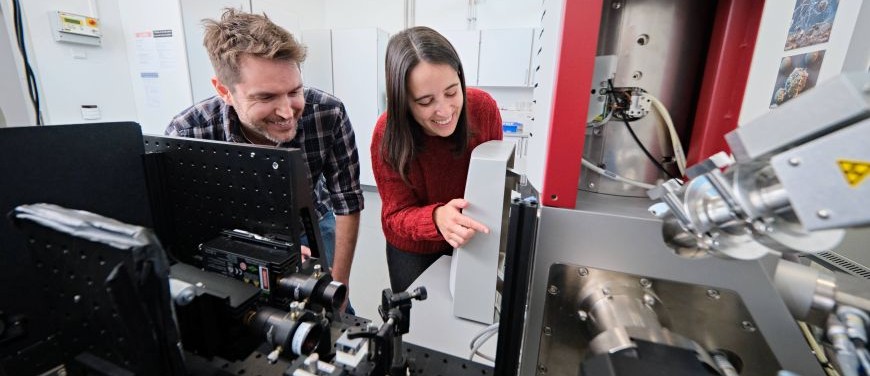
Scanning electron microscopy-based cathodoluminescence (SEM-CL) spectroscopy is a central tool in POLIMA's experimental portfolio, enabling the nanoscale characterization of light-matter interactions in photonic and plasmonic systems with nanometric spatial resolution and millielectronvolt spectral sensitivity. The technique is actively used within POLIMA to study 2D materials, plasmonic nanostructures, and diamond color centers, and the new infrastructure acquired through this grant — an infrared detection system and a cryogenic cooling stage — will significantly expand these capabilities across all these research areas, while also opening a new research direction in the nanoscale characterization of OPV materials. OPV materials present distinct challenges for SEM-CL: their low bandgaps place characteristic luminescent features in the near-infrared, beyond the range of conventional CL detectors, and their susceptibility to thermal degradation under electron beam exposure demands active sample cooling. Addressing these challenges through a collaboration with the SOLEN Elite Center at SDU, this project will establish the first CL characterization platform for OPV materials in Denmark — with broader benefits for the wider nanophotonics research carried out at POLIMA.
Project period 2025-2027
More information about the project
The work is organized around the following key efforts:
Extension of the SEM-CL detection range into the near-infrared. OPV materials absorb and emit light predominantly in the near-infrared region of the electromagnetic spectrum, beyond the spectral window of conventional CL detectors (~300–800 nm). The project acquires an infrared detection system supplied by Delmic — the company that produced the CL equipment at POLIMA — which extends the detection window to ~300–1700 nm. This upgrade includes a modular lens system to focus higher-wavelength radiation onto a near-infrared InGaAs array detector, a spectrometer grating for spectral resolution, and a deep-cooling chiller to minimize thermal noise, thus covering the full spectral region where OPV materials exhibit luminescent features.
Integration of a cryogenic cooling stage to prevent thermal degradation. Organic molecules used in OPV devices typically have low glass transition temperatures, making them highly susceptible to thermal degradation under the heat generated by electron bombardment. The project integrates a C.80 Cryo Module (LN2) supplied by Kammrath & Weiss GmbH, which uses a controlled flow of liquid nitrogen to maintain OPV samples at sufficiently low temperatures during measurements to avoid degradation, while also enabling future studies of thermally induced molecular disorder across a wide temperature range.
Nanoscale characterization of OPV materials in collaboration with SOLEN and CAPE. The upgraded SEM-CL setup will be applied to characterize state-of-the-art OPV materials fabricated at the Centre for Advanced Photovoltaics and Thin-film Energy Devices (CAPE) at SDU, a member of the SDU Climate Cluster Elite Center on Solar Energy Conversion and Storage (SOLEN). Dr. Catarina Ferreira, who bridges the efforts of POLIMA and SOLEN, will carry out CL measurements drawing on the expertise of Prof. Cox's group in the theoretical description of nanoscale light-matter interactions mediated by energetic electron beams to interpret the experimental results.

Grant holder Joel D. Cox

Co-PI Catarina Ferreira