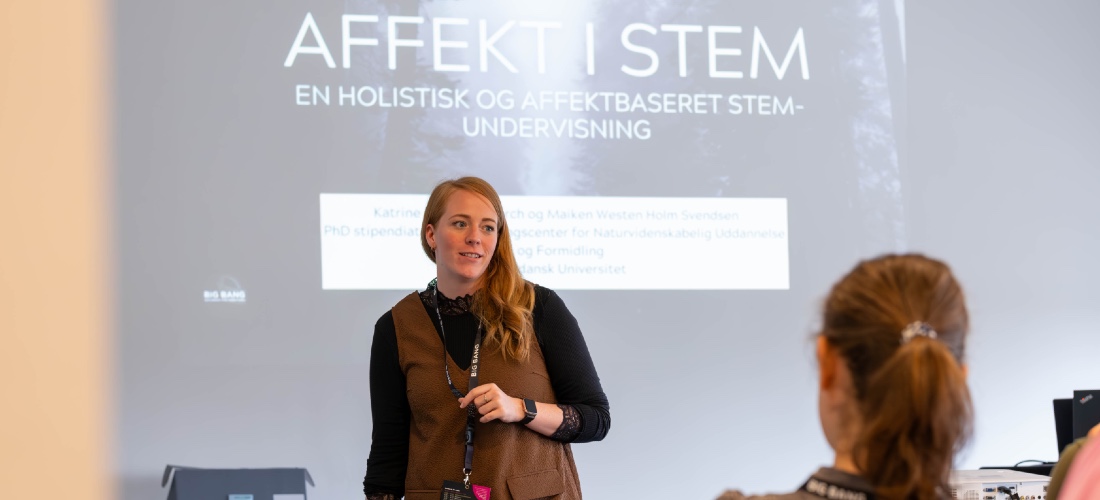
Maiken Westen Holm Svendsen defends her PhD dissertation on March 25, 2026.
Evaluation in mathematics is not just measurement – it also builds subject knowledge.
Maiken Westen Holm Svendsen defends her PhD dissertation Towards a More Coherent Evaluation Culture in Mathematics at HTX on Wednesday, March 25, 2026, from 13:00 to 16:00. In connection with the defense, she will give a public lecture titled "Towards a More Coherent Evaluation Culture in Mathematics at HTX – STEM Modules Between Learning, Competence, and Knowledge".
How do we actually determine what counts as “good” mathematical proficiency in upper secondary education?
That question is central to Maiken Westen Holm Svendsen’s PhD dissertation, which offers a new perspective on assessment in mathematics at HTX.Instead of viewing assessment as a neutral measurement of students’ knowledge, the dissertation shows how assessment in practice shapes both teaching and students’ academic opportunities.
A break with the traditional view of assessment
In many educational contexts, assessment is described as something objective—a neutral way to determine whether the student “knows the material.”Maiken Westen Holm Svendsen’s research challenges this understanding. She argues that assessment is always situated, relational, and co-constructive, and therefore helps define what appears as legitimate mathematical proficiency and which student expressions are given space.
The dissertation draws on a posthumanist and new materialist philosophy of science inspired by Karen Barad’s agential realism (the idea that the world and knowledge are created through relationships between humans and materials) and Andrew Pickering’s understanding of practice. Based on this, Svendsen develops a performative paradigm in which assessment is not seen as a reflection of pre-existing knowledge, but as something that emerges through interactions between students, teachers, artefacts, and teaching materials. In the study, she uses diffractive analysis (an approach where materials are read through one another to identify differences and new patterns, rather than comparing them one-to-one)—a method that makes it possible to discover shifts, patterns, and processes of materialization in new ways.
A postmodern perspective on mathematics teaching
The empirical part of the dissertation is based on cases from LabSTEM+ at HTX, where teaching and assessment situations are analyzed as “toy systems.” They function as small, experimental spaces of practice where subject knowledge, materials, and expectations are connected in ways that highlight certain forms of mathematical expression while others fade into the background.
Here, Maiken Westen Holm Svendsen shows how even small changes in format, materials, or task understanding can alter which forms of mathematics students are able to express—verbally, in writing, physically, or affectively.
New conceptual tools for teachers and researchers
- the didactic prism – a conceptual tool that visualize how student, teacher, content, and artefacts intra-act in the assessment situation
- the kaleidoscope – a figure that illustrates how subject knowledge can materialize differently depending on the sociomaterial conditions
These two models make it possible to understand assessment as a dynamic process in which subject knowledge is not merely measured, but produced.
Performative assessment – a new perspective on mathematical proficiency
The dissertation culminates in the concept of performative assessment, which offers three overall contributions:
- Theoretical: A new understanding of assessment, subject knowledge, validity, and reliability as situated practices.
- Methodological: The introduction of toy systems and sociomaterial figurations as analytical tools.
- Didactic: Recommendations for assessment practices that can accommodate mathematical proficiency as more than the reproduction of formal procedures.
A broader and more important perspective on what mathematics can be
Maiken Westen Holm Svendsen’s research shows that assessment is not a final control mechanism, but an active part of the development of the subject. By understanding assessment as a performative practice, it opens up more inclusive and diverse ways of seeing and evaluating students’ mathematical work.
Meet the researcher
Maiken Westen Holm Svendsen has completed her PhD dissertation at the STEM Center for Educational Research – FNUG under the supervision of Professor Connie Svabo, founding head of FNUG, and Associate Professor Dorte Moeskær Larsen, head of the center, FNUG.
The assessment committee
- Professor Martin Carlsen, University of Agder, Norge
- Lektor Gitte Miller Balslev, STEM Center for Educational Research – FNUG, SDU (chair of the assessment committee)
- Lektor Lykke Brogaard Bertel, Aalborg University
Supervisors
- Professor Connie Svabo, STEM Center for Educational Research – FNUG, SDU
- Associate Professor Dorte Moeskær Larsen, STEM Center for Educational Research – FNUG, SDU