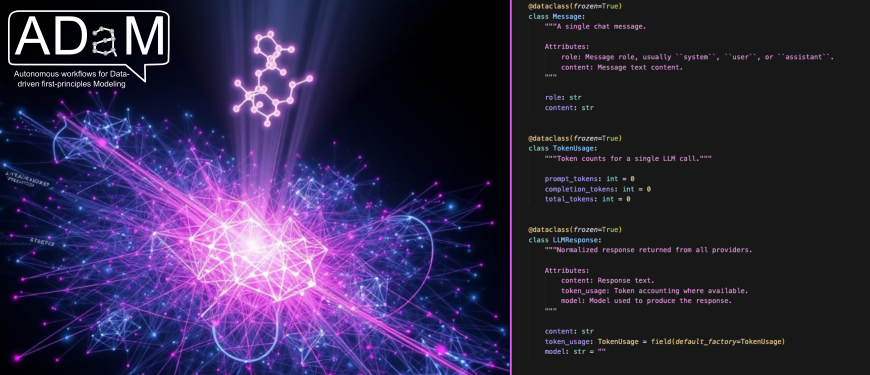
This project aims to democratize access to advanced materials simulations while promoting efficient and environmentally conscious use of computational resources. This will be achieved by developing a framework that leverages agentic Large Language Models (LLMs) to autonomously orchestrate and optimize Density Functional Theory (DFT) workflows. The target group includes researchers, R&D personnel, and students in condensed matter physics, chemistry, and related fields who need accessible and scalable first-principles computational tools.
More information about the project
First-principles simulations are quantum mechanical methods that rely solely on knowledge of the constituent atoms, rather than empirical parameters, allowing for the characterization of entirely unexplored materials. A major challenge in performing such investigations is the complexity and resource intensity of setting up and converging accurate simulations, which often limits their use to ADaM: Autonomous workflows for Data-driven first-principles Modeling expert groups and slows discovery. By using LLMs not only as intelligent user guides but also as active agents capable of predicting optimal computational settings, the project thus addresses key barriers related to both accessibility and efficiency.
The framework will connect LLMs with established software codes for performing DFT, timedependent DFT, GW, and Bethe–Salpeter equation calculations, enabling automated and resourceefficient predictions of key properties such as optical gaps and exciton binding energies in solids and molecules. Benchmarking will be performed on technologically relevant semiconductors and molecules to demonstrate accuracy and computational savings. Finally, the project will also explore the use of LLM reasoning and database knowledge to directly predict material properties and solve inverse design problems, with the potential to completely eliminate the high cost of explicit simulations and accelerate scientific discovery in areas such as renewable energy, optoelectronics, biosensing, and drug discovery.

The project 'ADaM: Autonomous workflows for Data-driven first-principles Modeling' is supported with a grant from the Novo Nordisk Foundation grant number NNF25OC0105410. Part of the program Data Science Investigator - Emerging 2025.