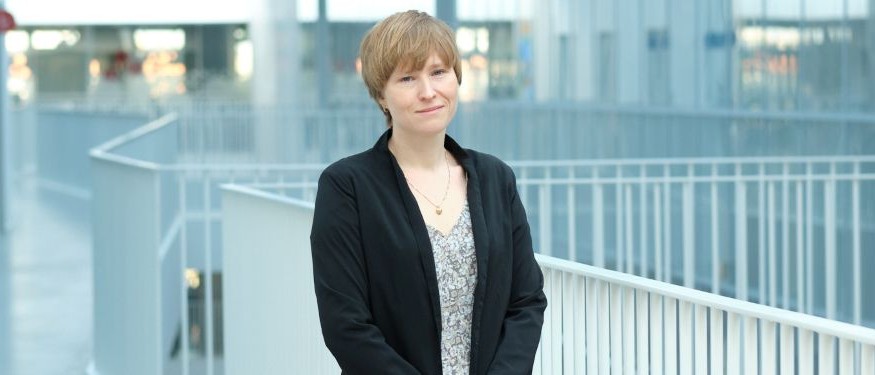
POLIMA is happy to invite for the inaugural seminar of Assistant Professor Line Jelver on 16 March at University of Southern Denmark.
• When: 1 PM, 16 March 2026
• Where: Meeting Room Ellehammer, 2nd floor in the main building of Faculty of Engineering, University of Southern Denmark, Campusvej 55, 5230 Odense M. SDU Map
• Registration: No registration needed, everyone is welcome!
Program:
• Welcome by Principal Investigator N. Asger Mortensen
• Guest speaker Marjan Krstic (Karlsruhe Institute of Technology/KIT) presents “A scale-bridging framework for (non-)linear optical properties of molecular materials, structures and devices thereof”
• Guest speaker Christof Holzer (Karlsruhe Institute of Technology/KIT) presents “Predicting Light: Quantum Chemistry meets Photonics”
• Break at 2 – 2.15pm
• Line Jelver presents “Neural Networks for Computational Condensed Matter Physics”
Everyone is welcome and POLIMA would like to invite for a reception afterwards.
Title: Neural Networks for Computational Condensed Matter Physics
Abstract:
Neural networks and, more recently, large language models (LLMs), are becoming powerful tools for accelerating and augmenting computational physics. In this seminar, I will give a gentle introduction to these methods and discuss how they can be integrated into modern condensed matter workflows, with an emphasis on optical response modeling and the automation of first-principles simulations.
First, I will present a deep-learning framework for the forward prediction and inverse design of thin-film multilayer stacks used in nanophotonics applications such as structural color generation, antireflection coatings, and thermally functional surfaces. Designing these stacks is challenging because the mapping from materials and thicknesses to color coordinates is highly nonlinear and interference-driven, while the inverse problem—finding layer configurations that realize a target color—is inherently non-unique. I will show how combining differentiable forward models with population-based optimization enables efficient inverse design within a single, integrated pipeline.
Second, I will describe ongoing work toward data-driven automation of complex first-principles materials modeling workflows. State-of-the-art simulations often require multi-stage procedures, careful convergence testing, and expert parameter choices across several specialized software packages. The goal of this project is to reduce this overhead by learning from prior calculations to recommend simulation strategies, convergence criteria, and parameter settings automatically. As a concrete starting point, I will focus on the entry step of many workflows: Defining the crystal structure. This includes an assessment of how accurately different LLMs can identify a material from user input and return the crystallographic information needed to initialize density functional theory (DFT) calculations.