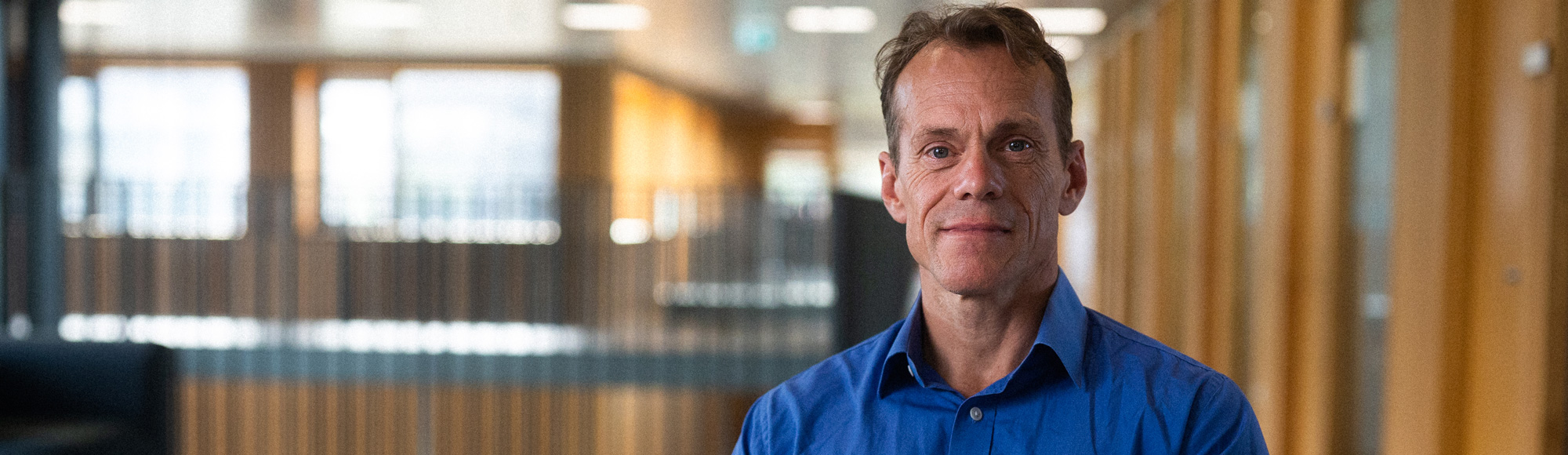
DIAS Chair Samuel Cushman to co-lead DKK 50 million centre for ecosystem recovery
The Carlsberg Foundation has awarded DKK 50 million to establish the Danish Centre for Ecosystem Recovery. Co-led by DIAS Chair Samuel Cushman, the new centre will bring ecology and landscape architecture together to help predict how landscapes can be transformed for the benefit of nature, climate and people.
How can we redesign landscapes to restore nature while improving human life – and how can we know whether those changes will succeed?
These questions will drive the Danish Centre for Ecosystem Recovery (DanCER), a new interdisciplinary research centre jointly led by Professor Samuel Cushman of the University of Southern Denmark and Professor Ellen Braae of the University of Copenhagen.
The centre has received DKK 50 million from the Carlsberg Foundation and will run for six years. DanCER is one of only three Carlsberg Foundation Interdisciplinary Research Centres selected in connection with the foundation’s 150th anniversary.
For Cushman, who is Professor of Biology and DIAS Chair of Science at the Danish Institute for Advanced Study, the centre marks a significant milestone in a career devoted to understanding landscapes as connected systems.
Turning landscape change into knowledge
Across Denmark and beyond, considerable resources are being invested in nature restoration and climate adaptation. Yet predicting which projects will succeed - and which changes will remain effective over time - is still difficult.
Ecological processes, landscape history, spatial design and the ways people use and value landscapes are often studied separately. DanCER will bring these perspectives together.
Using Denmark’s ongoing land-use reforms as a real-world laboratory, the centre will examine how spatial patterns, ecosystems and human activity interact as landscapes change. Its ambition is to develop practical, science-based principles for creating landscapes that are biodiverse, climate-resilient and valued by the people who live in and around them.
Researchers will combine remote sensing and historical data with field studies and public input. By comparing predicted and observed outcomes, testing alternative spatial designs and continuously refining its models, DanCER aims to build a shared foundation for making better decisions about future landscape transformation.
The resulting models will address changes in biodiversity, carbon, water and human interaction with the landscape. Crucially, they are intended to be both testable and transferable, allowing insights developed in Denmark to inform restoration efforts elsewhere.
An interdisciplinary challenge
DanCER brings together researchers from landscape ecology and landscape architecture, including ecologists, landscape researchers and designers.
That combination is central to the project. Restoring an ecosystem is not only a biological challenge. It is also a question of spatial design, history, governance and human behaviour. Whether landscape transformation succeeds depends not only on what happens in nature, but also on how people understand, use and care for the places around them.
In a DIAS Spotlight interview earlier this year, Cushman described the challenge of balancing biodiversity, climate action, agriculture, economic concerns and human well-being as “the ultimate wicked problem in interdisciplinary complexity.”
DanCER now provides a long-term framework for pursuing precisely that ambition: bringing different forms of expertise together around a problem that no single discipline can solve alone.
Samuel Cushman

DIAS Chair of Science
One of three new national research centres
The Carlsberg Foundation received 58 applications for its interdisciplinary research centre initiative, representing requests totalling almost DKK 2.8 billion. Following external peer review and interviews with selected applicants, three centres were chosen to receive DKK 50 million each.
Together, the centres will explore ecosystem recovery, human cognition in the age of generative AI, and the societal development of quantum technologies.
The initiative reflects a belief shared by the Carlsberg Foundation and DIAS: that new ideas and forms of knowledge emerge when disciplines meet around ambitious questions.
DIAS warmly congratulates Samuel Cushman, Ellen Braae and the entire DanCER team on this remarkable achievement.
Read more about the Danish Centre for Ecosystem Recovery at the Carlsberg Foundation's webstite