The DDCxTrygFonden Fellowship Cohort of 2027
We are very excited to announce our 2027 DDCxTrygFonden fellowship cohort! The fellowship program is funded by TrygFonden and brings together leading researchers, journalists, and policy experts from diverse backgrounds to explore the profound impact of digital technology and Artificial Intelligence (AI) on media, politics, and democracy.
The fellows will be affiliated with the DDC, collaborating with mentors and partners to generate new knowledge, contribute to the public debate, and produce tangible outputs such as policy briefs and educational packages. Their projects tackle critical issues across the DDC’s core research themes: Digital Democratic Integrity, AI, Media, and Journalism, Citizens, Organisations, New Digital Technologies, Digital Democracy and Societal Transitions. A special emphasis was placed on the overarching theme of "Hybrid Warfare" in this year's call.
For this fourth round of our fellowship program, we have a diverse cohort of over 20 fellows with backgrounds in academia, journalism, and policy-making:
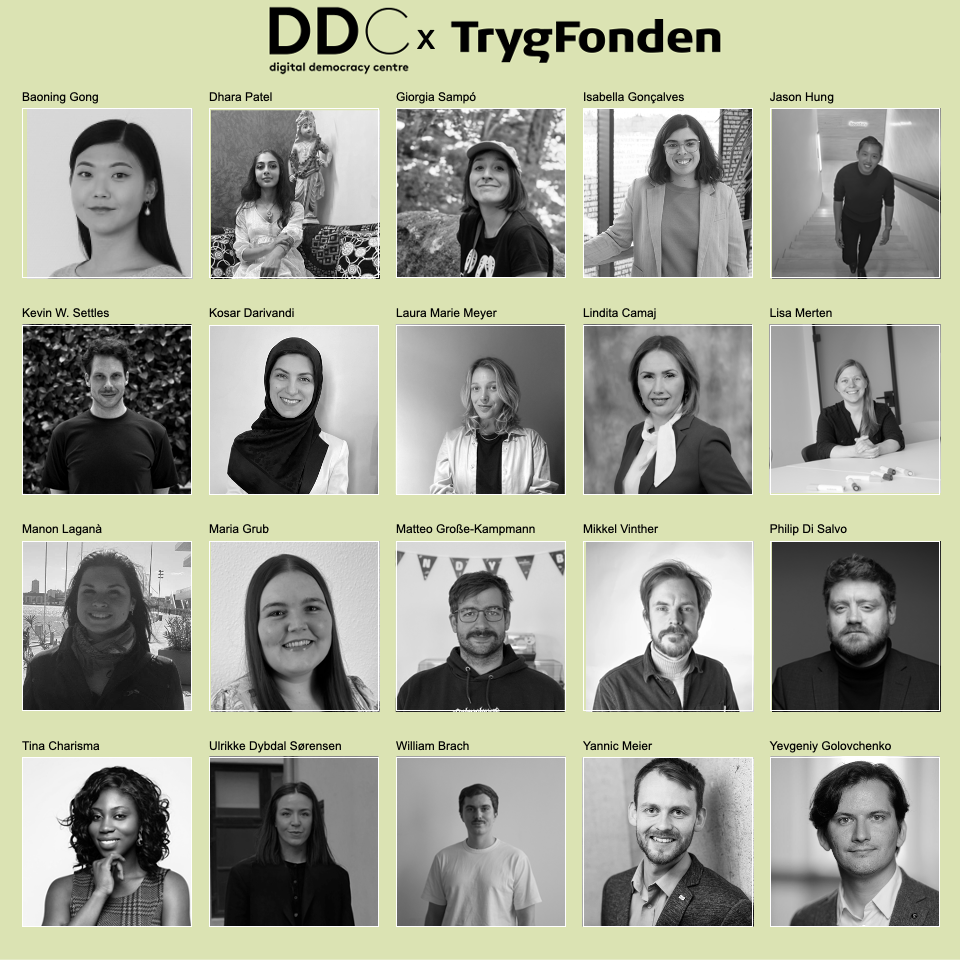
Meet the 2027 Fellows:
Here is a quick overview of the incoming fellows and their upcoming work:
Baoning Gong: Of Networks, Semantics, and Institutions: Toward a Framework for Analyzing the Far Right as a Platformed Formation
Dhara Patel: AI Surveillance, Digital Democracy, and Women's Freedom of Expression: A Comparative Study of India and Denmark
Giorgia Sampó: Fostering Civic Participation: What Can We Learn from Decentralized Governance?
Isabella Gonçalves: Facing media hostility: perceptions and attitudes of journalists in training in Denmark and Germany
Jason Hung: Beyond Proxy Measurement: AI-Specific Indicators for Denmark’s Information Environment
Kevin W. Settles: The Ghost in the Procedure: Control, Epistemic Authority, and AI in the Folketing
Kosar Darivandi: From routine to hybrid-threat crisis: adaptive governance of digital volunteer platforms
Laura Marie Meyer: Cloud Infrastructure and Democratic Resilience: Shaping Europe’s Cloud Architecture in the Age of Hybrid Warfare
Lindita Camaj: Information Stewardship as a form of Democratic Resilience: A framework for accessible and trustworthy public data infrastructures
Lisa Merten: A Healthy Dose of Doubt? Epistemic Resilience in High-Choice Information Environments
Manon Laganà: Electoral Surveillance in the Age Of Social Media and AI: Towards a “Cambridge Analytica 2.0”
Maria Grub: Misinformation “Live” – Moderation of food-related health misinformation on Twitch
Matteo Große-Kampmann: Threat Modelling AI-Enabled Influence Campaigns and Public Perceptions in Germany and Denmark
Mikkel Vinther: The necessary cooperation between national law enforcement authorities and the tech giants
Philip Di Salvo: From Exposure to Understanding: Audiences and AI Accountability Journalism in Denmark and Switzerland
Tina Charisma: Governing Digital Futures: AI, Democracy, and Public Trust
Ulrikke Dybdal Sørensen: Engagementmaxxing and Information Type Dominance in the Danish Digital Information Environment
William Brach: Poisoning the Well: AI Reading Agents as an Attack Surface for Information Operations
Yannic Meier: When literacy is not enough. Conceptualizing and testing an approach to digital resilience to adaptively cope with individual and societal digital threats
Yevgeniy Golovchenko: Understanding the political communication of hybrid warfare
Individual Fellow Project Overviews
Baoning Gong
Project Title: Of Networks, Semantics, and Institutions: Toward a Framework for Analyzing the Far Right as a Platformed Formation.
Bio: Baoning Gong is a German PhD student in communication science at the Weizenbaum-Institute in Berlin. She researches online far-right ecosystems using network analysis and quantitative and qualitative content analysis. Her research examines far-right actor networks across social media platforms, how emerging far-right authorities claim journalistic authority, and how far-right actors construct and communicate collective identities across platforms.
Project Focus: At the DDC, Baoning will develop a theoretical framework to explain how far-right structures emerge through digital platform communication across relational, semantic, and institutional dimensions, informing both academic research and practice.
DDC Mentor: Curd Knüpfer.
Dhara Patel
Project Title: AI Surveillance, Digital Democracy, and Women's Freedom of Expression: A Comparative Study of India and Denmark.
Bio: Dhara Patel is an Indian journalist and researcher focused on gender justice and digital rights.
Project Focus: Dhara will compare how digital surveillance, AI-enabled online abuse, and digital governance affect women journalists’ freedom of expression and democratic participation in Gujarat, India, and Denmark, drawing on interviews, case studies, and policy analysis.
DDC Mentor: Thomas Enemark Lundtofte.
Giorgia Sampó
Project Title: Fostering Civic Participation: What Can We Learn from Decentralized Governance?
Bio: Giorgia Sampó is a researcher in organizational design and decentralized governance (University of Southern Denmark). She studies the relationship between technology, governance structures, and organizational outcomes in digital organizations, with a particular focus on blockchain-based communities.
Project Focus: Giorgia will explore what digital platforms for civic participation can learn from decentralized autonomous organizations (DAOs). Working with the civic platform Gloki, she will investigate how different governance mechanisms can make collective decision-making more inclusive, transparent, and legitimate.
DDC Mentor: Marco Perossotti.
Isabella Gonçalves
Project Title: Facing media hostility: perceptions and attitudes of journalists in training in Denmark and Germany.
Bio: Isabella Gonçalves is a postdoctoral researcher at Johannes Gutenberg University Mainz. Her research examines the role of media and platforms in democratic belonging and epistemic inequalities, addressing topics such as the othering of outgroups, negative and divisive political campaigning, and anti-media hostility.
Project Focus: As a Digital Democracy Centre X TrygFonden Fellow, she will investigate to what extent perceptions of media hostility and media freedom instability affect journalists in training. The project follows a mixed-methods, comparative design (Germany and Denmark), combining a survey with participant observation methods.
DDC Mentor: Lena Frischlich.
Jason Hung
Project Title: Beyond Proxy Measurement: AI-Specific Indicators for Denmark’s Information Environment.
Bio: Jason Hung holds a PhD in Sociology from the University of Cambridge and a C2F Postdoctoral Fellowship at Chulalongkorn University. He is the founder of the Global AI Dataset (GAID) Project and the co-founder of the CORDA Democratic AI-Readiness Index and the HIV Funding Impacts initiative.
Project Focus: Built upon his co-founded CORDA Democratic AI-Readiness Index (2025 edition), he will ask whether Denmark’s top ranking in the index holds without proxy measurement. He will also construct Denmark’s first AI-specific information environment indicators from Danish-language multi-platform data, re-estimate its driver scores and develop the index’s early-warning methods.
DDC Mentor: Josephine Lukito.
Kevin W. Settles
Project Title: The Ghost in the Procedure: Control, Epistemic Authority, and AI in the Folketing.
Bio: Kevin Settles is a political scientist, doctoral researcher, and research associate at the Institute for Parliamentary Research (IParl) in Berlin, as well as a lecturer at the University of Kassel. His research focuses on parliamentary institutions, political representation and communication, and digitalization, particularly the integration of artificial intelligence into parliamentary work and governance.
Project Focus: Kevin will investigate how artificial intelligence (AI) is introduced and used in the Danish Folketing, examining how AI systems become part of parliamentary work and how control over their use and outputs is exercised and negotiated. Situated within a broader comparative study of AI in parliaments, the project explores what these developments mean for institutional practices, epistemic authority, and democratic accountability.
DDC Mentor: Curd Knüpfer.
Kosar Darivandi
Project Title: From routine to hybrid-threat crisis: adaptive governance of digital volunteer platforms.
Bio: Kosar Darivandi holds a PhD in management from Sharif University of Technology, Iran. Her research examines solutions for organizing citizens and spontaneous volunteers for disaster response, with particular emphasis on the role of digital technologies and agent-based modeling.
Project Focus: Kosar will develop an agent-based simulation model to explore when digital volunteer platforms should reallocate decision rights between central coordinators and volunteers in response to crises, and whether adaptive governance outperforms fixed centralized or decentralized designs.
DDC Mentor: Oliver Baumann.
Laura Marie Meyer
Project Title: Cloud Infrastructure and Democratic Resilience: Shaping Europe’s Cloud Architecture in the Age of Hybrid Warfare.
Bio: Laura is pursuing a PhD at the European New School of Digital Studies (ENS) at the European University Viadrina, where her research explores the intersection of power, infrastructures, and digital sovereignty from an International Relations perspective.
Project Focus: During her fellowship at the DDC, Laura will investigate the potential of different sovereign cloud infrastructures to strengthen democratic resilience in the face of hybrid warfare. Building on this research, she will develop a policy toolkit.
DDC Mentor: Ingvild Bode.
Lindita Camaj
Project Title: Information Stewardship as a form of Democratic Resilience: A framework for accessible and trustworthy public data infrastructures.
Bio: Lindita Camaj is an associate professor in journalism at the University of Florida, with a research agenda at the intersection of journalism, technology, and access to information. Her latest work explores digital innovations in global journalism, focusing on open data infrastructures, data journalism and cross-border collaborations.
Project Focus: Her project will map out how journalism communities are contributing to democratic information resilience by preserving, curating, and translating public records into user-friendly digital infrastructure. Using a comparative case-study approach, it will compare different democratic models of information stewardship and produce a practical framework useful for news media and civil society organizations.
DDC Mentor: Claes de Vreese.
Lisa Merten
Project Title: A Healthy Dose of Doubt? Epistemic Resilience in High-Choice Information Environments.
Bio: Lisa Merten is a German Senior Researcher in Communication Science at the Leibniz Institute for Media Research | Hans-Bredow-Institut, Germany.
Project Focus: Doubt can foster critical engagement with information, but excessive skepticism or even cynicism may undermine trust in reliable sources and institutions. Drawing on representative surveys in Denmark and Germany, Lisa investigates how citizens calibrate doubt and when skepticism supports informed judgment or increases vulnerability to information manipulation.
DDC Mentor: Curd Knüpfer.
Manon Laganà
Project Title: Electoral Surveillance in the Age Of Social Media and Ai: Towards a “Cambridge Analytica 2.0”.
Bio: Manon Eleonora Lagana holds a PhD in Law and an LLM in International and European Studies from the University of Valencia, Spain, and is the coordinator of the research project “Preventing and Fighting University Digital Violence Through Awareness Student-Led Strategies and Academic Outreach Initiatives”.
Project Focus: The project examines how social media, algorithmic profiling, and artificial intelligence may facilitate electoral surveillance, political manipulation, and disinformation during the current global electoral cycle, potentially undermining democratic integrity and voter autonomy while raising concerns about compliance with international and national digital regulatory frameworks.
DDC Mentor: Ayo Næsborg-Andersen.
Maria Grub
Project Title: Misinformation “Live” – Moderation of food-related health misinformation on Twitch.
Bio: Maria Grub is a PhD candidate in political communication (University of Jena).
Project Focus: Maria will conduct experimental surveys in Denmark and Germany to assess the effects of food-related misinformation on the live-streaming platform Twitch.
DDC Mentor: Lena Frischlich.
Matteo Große-Kampmann
Project Title: Threat Modelling AI-Enabled Influence Campaigns and Public Perceptions in Germany and Denmark.
Bio: Matteo Grosse-Kampmann is a Professor of Distributed Systems at Rhine-Waal University of Applied Sciences. His research focuses on the analysis of security and privacy in distributed systems.
Project Focus: Matteo is bringing his expertise in security to DDC, where he is exploring with Peter how the general public perceives cognitive influence campaigns so that safeguards can be efficiently developed and used.
DDC Mentor: Peter Mayer.
Mikkel Vinther
Project Title: The necessary cooperation between national law enforcement authorities and the tech giants.
Bio: Mikkel Vinther is a Danish legal officer specializing in digital law (Center for social media, tech and democracy in the Ministry of Science, Higher Education and Digital Affairs).
Project Focus: Mikkel will investigate the necessary cooperation between Danish law enforcement authorities and the tech giants, with the aim of strengthening the general sense of justice in the digital world (den digitale retsfølelse) among citizens in Denmark. Mikkel will map out the challenges faced by law enforcement authorities, when cooperating with the tech giants, and propose solutions on how to counter these challenges.
DDC Mentor: Ayo Næsborg-Andersen.
Philip Di Salvo
Project Title: From Exposure to Understanding: Audiences and AI Accountability Journalism in Denmark and Switzerland.
Bio: Philip Di Salvo is a Senior Researcher in journalism and algorithmic cultures at the University of St. Gallen. He brings his expertise in hybrid and algorithmic forms of investigative reporting to the Digital Democracy Centre, where he will be examining how audiences in Denmark and Switzerland make sense of journalism about algorithmic power, and for whom such reporting becomes meaningful.
Project Focus: Philip will be working on the perception and understanding of AI accountability journalism among Danish and Swiss audiences, comparing what investigative reporting on algorithmic systems conveys with what readers actually take from it, as part of a project to identify how media systems and public discourse shape the democratic reach of accountability journalism.
DDC Mentor: Lene Heiselberg.
Tina Charisma
Project Title: Governing Digital Futures: AI, Democracy, and Public Trust.
Bio: Tina Charisma is a researcher and strategic advisor working across AI governance, public policy, culture, and civic life. Her work examines how emerging technologies shape public trust and democratic participation and who benefits from scientific and technological advances. She founded Charisma Campaign, and her reporting has appeared in outlets including CNN, Observer, Harper’s Bazaar, Vulture (New York Magazine), and HuffPost. She holds a master’s degree in International Development and Education from University College London and an undergraduate degree in International Relations and Sociology.
Project Focus: At the Digital Democracy Centre, Tina will explore how AI and emerging technologies are reshaping media and public trust. She will examine how audiences assess the credibility ofdigital information and what this means for education, science communication, and democratic participation. Her research will consider how policymakers and media institutions can respond as AI becomes more embedded in civic life, and how the decisions they make today could shape how future generations access information and participate in democracy.
DDC Mentor: David Hopmann.
Ulrikke Dybdal Sørensen
Project Title: Engagementmaxxing and Information Type Dominance in the Danish Digital Information Environment.
Bio: As the first and only embedded researcher at the Centre for Social Media, Tech, and Democracy, Ulrikke will explore what content is algorithmically amplified, and how it shapes the digital information environment. Anchored in one of Denmark’s central tech policy offices, the project will inform efforts on transparency and digital governance, where Ulrikke brings her expertise in research-informed policymaking to the Digital Democracy Centre.
Project Focus: By leveraging engagement metrics as a structural proxy for exposure and examining the informational composition and content type dominance, Ulrikke will be working on a cross-platform study of how social media influence increasingly extends beyond the algorithmic to epistemic shifts, affecting the quality of Danish democratic debate as it unfolds on social media and digital platforms.
DDC Mentor: Josephine Lukito.
William Brach
Project Title: Poisoning the Well: AI Reading Agents as an Attack Surface for Information Operations.
Bio: William Brach is a Computer Science PhD candidate at FIIT STU in Bratislava, researching the security and safety of large language models and web-based AI agents. He studies how manipulated web content and prompt injection influence these systems, and how to defend them against information manipulation. He is also co-founder of sommify, where he builds AI agents for the wine industry.
Project Focus: The project investigates how coordinated actors manipulate web content to steer AI agents that read the web and spread disinformation. It measures how much these attacks cost, how effective they are, and how easily they can be detected. It also develops defences to make these agents safer and help protect democratic societies against information manipulation.
DDC Mentor: Lukas Galke Poech.
Yannic Meier
Project Title: When literacy is not enough. Conceptualizing and testing an approach to digital resilience to adaptively cope with individual and societal digital threats.
Bio: Yannic Meier is a postdoctoral researcher in Media Psychology at the University of Duisburg-Essen, Germany.
Project Focus: Yannic’s project focuses on conceptualizing and studying digital resilience, which is hypothesized to be a favorable combination of variables, such as knowledge, skills, mindsets, and resources, that help users adaptively cope with various digital threats, including those posed by hybrid warfare tactics.
DDC Mentor: Hannah Decker.
Yevgeniy Golovchenko
Project Title: Understanding the political communication of hybrid warfare.
Bio: Yevgeniy Golovchenko is an Assistant Professor at the Department of Political Science and SODAS at the University of Copenhagen. His research lies at the intersection of international security, political communication, and computational social science, with a focus on the informational aspects of hybrid warfare, such as disinformation and censorship, as well as sanctions evasion.
Project Focus: The project aims to explore the relation between hybrid threats and citizen opinions as well as trust in public institutions. The goal is to bring together theoretical insights from the literature on hybrid warfare in security studies with theories and empirical frameworks from political communication.
DDC Mentor: Claes de Vreese.