
Young people with heavy substance use face a heightened risk of serious accidents and traumatic brain injuries
Danish teenagers who start drinking, smoking, using tobacco and nicotine products, and experimenting with drugs at an early age run a greater risk of ending up in hospital because of accidents, violence, and traumatic brain injuries. This is shown in a new study from the National Institute of Public Health.
The study is based on responses from about 68,000 young people aged 15–19 who, in 2014, were attending upper secondary school or vocational school. By linking the survey responses with national registers, the researchers identified four patterns of alcohol and substance use among the adolescents and followed them over eight years – from their teenage years into early adulthood, at ages 23–27 – to examine who was later hospitalized due to accidents, poisonings, or violence.
“About 30 percent of the young people have a substance-use pattern that includes cannabis and other drugs in addition to alcohol and tobacco or nicotine products. That is a large share, and it is striking, especially because we can see that these patterns are linked to an increased risk of acute, serious accidents,” says Sofie Kruckow, physician and PhD student at the National Institute of Public Health and one of the researchers behind the study.
The study shows, among other things, that young people who start early and also have a high level of substance use face a 50 percent higher risk of serious accidents and a 45 percent higher risk of traumatic brain injuries. They are also three times more likely to be involved in violent incidents and six times more likely to experience drug-related poisonings.
“These are serious injuries the young people risk. We see, for example, concussions, brain hemorrhages, nerve damage, spinal fractures, and injuries to internal organs. Some of these injuries can lead to long-lasting and severe consequences, including permanent brain damage, so it is certainly concerning,” says Sofie Kruckow.
The study has just been published in the European Journal of Public Health.
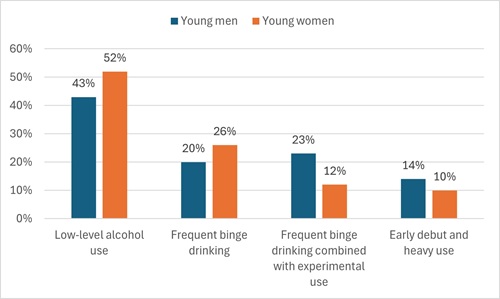
The figure shows the distribution of substance use among young men and women in upper secondary education aged 15–19.
Substance use rarely occurs in isolation
The researchers also examined the young people’s upbringing and social background. The analysis shows that many of those who start drinking and using drugs early more often come from homes with financial difficulties, alcohol problems, or limited parental support.
Professor Janne Tolstrup, who researches alcohol prevention and is co-author of the study, stresses that substance use seldom stands alone:
“Put simply, there is often a reason why some young people use many substances. Many struggle with psychological challenges or lack support at home. Life circumstances play a major role in the risk, and that is why early intervention is important.”
She also notes that the study covers only young people who are currently enrolled in an education programme.
“We are looking at a specific group of 15–19-year-olds who, on paper, are actually doing quite well, since they are in education. But that makes it all the more striking that their risk of accidents varies so much depending on their substance use,” she says.
Facts: Four patterns among young people
In the study, the researchers identified four overall patterns of substance use among young people aged 15–19:
- Low-level alcohol use: The largest group, 48 %, drinks alcohol only and typically in limited amounts – between 0 and 9 drinks per week. This group is the reference group used for comparing risk levels. Among the four groups, this group generally has the lowest risk of all types of accidents and violent incidents.
- Frequent binge drinking: 23 % often consume five or more drinks on a single occasion. This group has a 17 % higher risk of being hospitalized for alcohol poisoning, a 25 % higher risk of serious accidents, a 23 % higher risk of traumatic brain injuries, and a 51 % higher risk of hospital contacts due to violence.
- Frequent binge drinking combined with experimental use: 17 % combine frequent binge drinking with occasional smoking and experiment with cannabis and other tobacco or nicotine products such as e-cigarettes or waterpipes. They have a 37 % higher risk of hospitalization due to alcohol poisoning, nearly three times higher risk of hospitalizations related to drug use, a 40 % higher risk of serious accidents, and a 46 % higher risk of traumatic brain injuries. They are also more than twice as likely to have hospital contacts related to violence.
- Early debut and heavy use: 12 % had already tried being drunk and smoking cigarettes before age 13. As adolescents, they frequently drink heavily, smoke daily, use other tobacco and nicotine products, and experiment with several substances, including cannabis and cocaine. They have a 71 % higher risk of hospitalization due to alcohol poisoning, more than six times the risk of drug-related hospitalizations, a 50 % higher risk of serious accidents, and a 45 % higher risk of traumatic brain injuries. They also have more than 3.5 times the risk of hospital contacts due to violence.
Contact: PhD student Sofie Kruckow, tel.: +45 6550 7870, e-mail: kroc@sdu.dk, National Institute of Public Health, University of Southern Denmark.