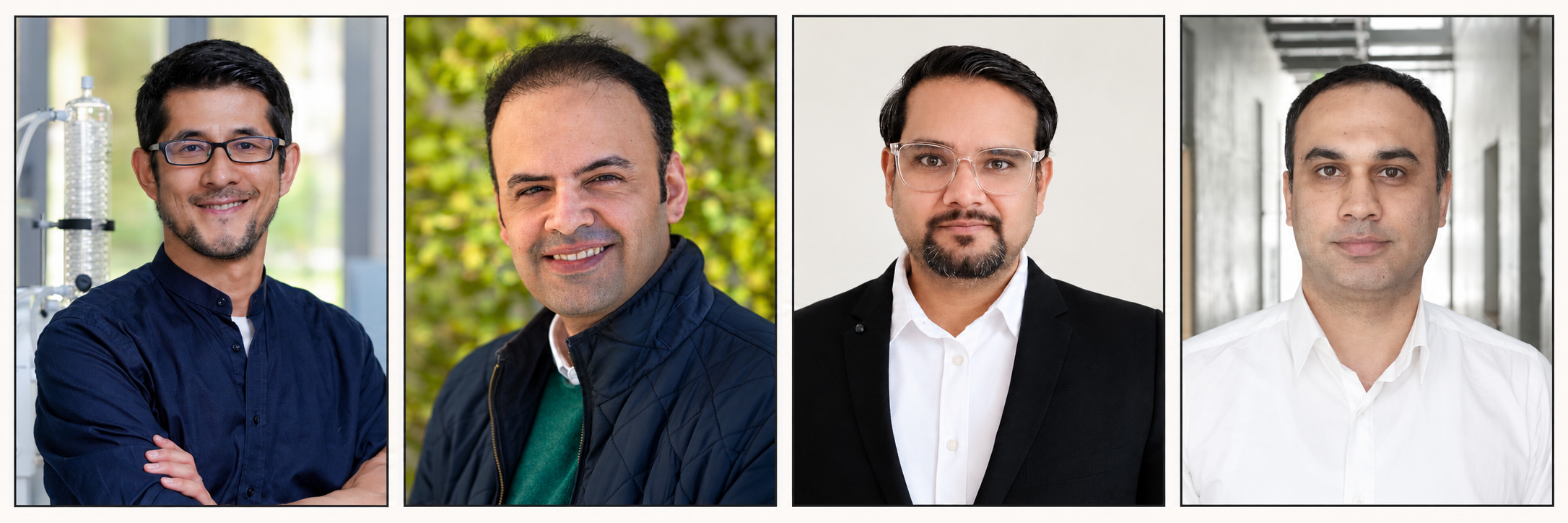
Four researchers from the Faculty of Engineering receive DKK 9.7 million for bold experiments
Four researchers from the Faculty of Engineering have received a combined total of almost DKK 9.7 million from Villum Experiment for projects exploring shape-changing materials, automated software repair, new catalysts and quantum-inspired computer hardware.
What if a material could use mechanical instability to change shape? What if software could repair its own errors without first knowing what the correct solution should look like? What if artificial intelligence could discover new catalysts for green hydrogen production? Or what if some of the key properties of quantum computers could be replicated in hardware operating at room temperature?
These are some of the questions that four researchers from the Faculty of Engineering at the University of Southern Denmark will now have the opportunity to explore with support from Villum Experiment.
The programme supports unconventional research ideas with a relatively high risk of failure but also the potential to produce major scientific breakthroughs. Applications are assessed anonymously, meaning that the reviewers do not know the researchers’ backgrounds or academic achievements. Instead, they assess the quality and originality of the ideas.
‘With Villum Experiment, we make room for research ideas that push the boundaries of what we believe is possible. They may turn out not to work, but they could also be the one wild idea capable of transforming a field of research – or the world,’ says Thomas Bjørnholm, Director of Research at the Villum Foundation.
This is the tenth time the Villum Foundation has awarded grants through the programme. Across Denmark, 53 researchers have received a combined total of DKK 129 million. Their projects were selected from 280 applications.
The four researchers from the Faculty of Engineering have received a combined total of DKK 9,675,000.
Materials that change shape
Bahman Taherkhani from the Maersk Mc-Kinney Moller Institute has received DKK 2,495,000 for the project Shape Changing Soft-Stiff Composites Through Mechanical Instabilities.
Mechanical instabilities are usually regarded as signs that a material is failing. However, they can also enable materials to change shape rapidly without sustaining damage.
The project will investigate whether shape changes in composites consisting of both soft and stiff materials can be described using a universal physical law. Today, these materials are largely studied on a case-by-case basis, and the results often depend on the specific geometry involved.
The aim is therefore to develop the first comprehensive energy-based phase diagram for this type of instability. Such a diagram could make it possible to predict when and how the materials will change shape.
If successful, the research could provide a new physical foundation for developing programmable materials capable of changing shape in a controlled manner.
Can software repair itself without being told what ‘correct’ looks like?
Abhishek Tiwari from the Maersk Mc-Kinney Moller Institute has received DKK 2,500,000 for the project Is Correctness Necessary? An Experiment in Test-Free Program Repair.
Software errors are unavoidable, and researchers have spent decades trying to develop systems capable of finding and repairing them automatically. Existing methods usually rely on a test, a specification or another form of control that tells the system how the corrected software is supposed to behave. The project challenges this fundamental assumption.
Instead, Abhishek Tiwari will investigate whether a system can repair errors using only the information already present in the program code. Among other things, the system will assess whether a change restores type consistency, matches patterns found in millions of other programs and represents the simplest possible correction.
When several independent signals point towards the same solution, the system can accept the repair. Not because it knows with certainty that it is correct, but because the structure of the code suggests that it is.
The experiment may show that reliable program repair requires a predefined understanding of correctness. However, it could also open an entirely new path towards software capable of finding and repairing errors without conventional tests.
Machine learning will search for new catalysts
Mirabbos Khujamberdiev from the Mads Clausen Institute has received DKK 2,431,000 for the project CatDPO: Machine Learning-Accelerated Exploration of Catalytic Double Perovskite Oxynitrides.
The project focuses on a group of materials known as double perovskite oxynitrides. These materials remain largely unexplored but may possess properties that make them promising catalysts.
New materials have traditionally been developed through slow and costly experiments in which researchers produce and test different compositions one at a time.
Using machine learning and AI-driven high-throughput methods, the researchers will instead investigate a large number of possible material compositions and predict their properties. Among other things, they will examine how different elements are arranged within the materials and how changes in composition affect their stability and electronic properties.
This will allow the researchers to identify the most promising candidates more quickly and focus their physical experiments on them.
The aim is to find stable materials with high catalytic performance that could be used for applications including solar energy conversion and green hydrogen production. The project will also establish a method for making the discovery of new catalytic materials faster and more targeted.
Quantum-inspired hardware at room temperature
Hooman Farkhani from the Department of Mechanical and Electrical Engineering has received DKK 2,249,000 for the project QUANTRONIC: Spintronic Pseudo-Qubits for Room-Temperature Quantum Computing.
Quantum computers could, in principle, solve certain tasks much faster than conventional computers. However, their quantum states are extremely sensitive to external disturbances, meaning that the technology usually requires highly controlled conditions and extremely low temperatures.
QUANTRONIC will investigate whether some of the key mechanisms of quantum computers can instead be replicated in electronic hardware operating at room temperature.
A conventional computer processes information using bits that have a value of either 0 or 1. The fundamental unit of information in a quantum computer is known as a qubit. It can exist in a combination of 0 and 1 until it is measured, enabling a quantum computer to process information in a fundamentally different way.
The project will develop spintronic pseudo-qubits based on magnetic tunnel junctions. They are not genuine qubits, but through controlled randomness and connections between electronic components, they are intended to replicate properties such as superposition, interference and correlations between qubits.
The researchers will investigate whether structured probability patterns resembling those found in quantum systems can emerge from the collective behaviour of conventional electronic components.
If successful, the experiment could establish a new form of computing positioned between conventional probabilistic computers and genuine quantum computers. In the longer term, it could pave the way for more scalable and manufacturing-friendly quantum-inspired hardware.