Research areas
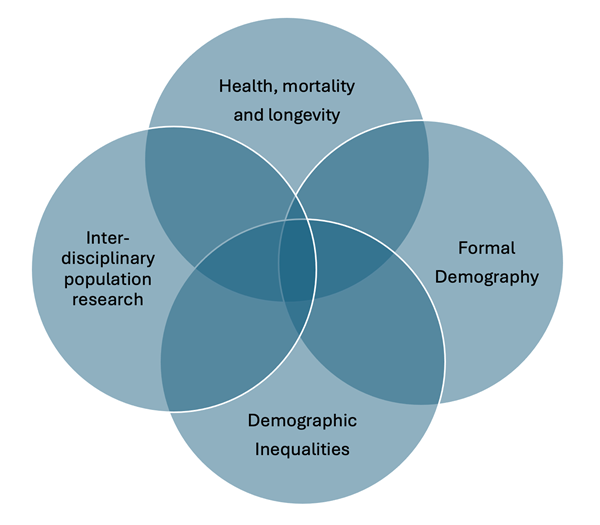
Health, mortality and longevity
As health improves, mortality risks decline, leading to longer lifespans. These improvements have continued for a century. At CPop, we seek to answer fundamental questions such as:
- How long do we live?
- In what conditions do we age?
- What do we die of?
Our team has led—and continues to lead—multiple studies on longevity extension, healthy life expectancy, physical and cognitive functioning, disease pathways, causes of death, multimorbidity trends and patterns, among other topics.
Demographic inequalities
In the past decades we have observed substantial changes in hygiene, nutrition and medical advancements, leading to reductions in mortality.
- Why is not everyone living long and healthy lives?
- How do these inequalities in lifespan ripple in other societal aspects?
The extent and evolution of inequalities within and between populations is a key research focus at CPop. Our team has identified and analyzed multiple dimensions of inequality, including inequalities in the length of life (lifespan inequalities), survival to retirement, and health outcomes.
We also investigate other forms of demographic inequality, such as differences in population growth. Why do some regions or municipalities experience rapid expansion, while others face depopulation? Our team investigates the causes and consequences of these variations in population growth.
Formal demography
CPop is a world leader in the development and application of innovative methods for analyzing demographic data and trends. In this area, we have contributed several new models, including:
- mortality forecasting models,
- methods for improving short-term forecasts and estimating excess deaths,
- new mathematical relationships and models to understand aging trajectories,
- approaches to integrate mortality and fertility analysis, and
- decomposition methods for demographic and health measures.
Interdisciplinary population research
Our research extends beyond demography, engaging with other disciplines, and contributing to societal discussions. We conduct research projects addressing key societal challenges in collaboration with experts from fields such as economics, political science and evolutionary biology. Our work has explored topics including the impact of the COVID-19 pandemic and the effectiveness of policy responses, the effects of Danish pension indexation on unequal access to retirement, how physical and cognitive functioning influence health and social care expenditures as well as studying the diversity of life course strategies across species.