21.08.2026
In this study, Boel and Klinggaard et al. generate a comprehensive multi-organ proteomic atlas of obesity and weight-loss-induced recovery in mice. They demonstrate that obesity triggers highly tissue-specific proteomic changes and show that, while most tissues return to a lean-like state after weight loss, several organs retain persistent alterations, revealing long-lasting effects of obesity across the body.
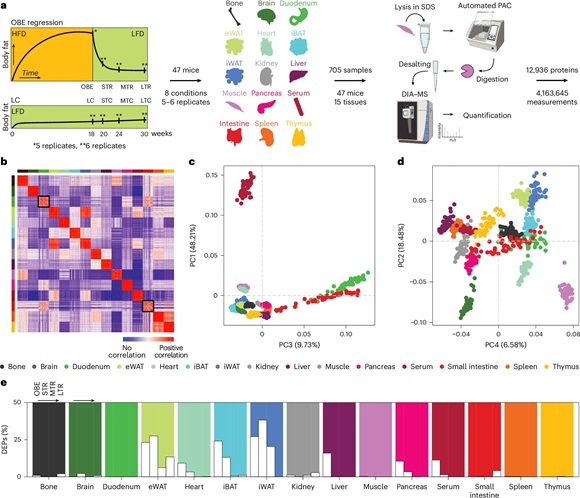
Obesity drives systemic metabolic dysfunction, yet how the body adapts and recovers at a system-wide level remains unclear. Here we generate a multi-organ proteomic atlas of diet-induced obesity and its regression in male mice. Using a standardized, semi-automated sample preparation workflow, we quantify 12,936 unique proteins across 15 organs and four timepoints. We find proteomic changes to be highly tissue-dependent, with a small number of proteins displaying shared changes across multiple tissues. While proteomes of most tissues revert to lean levels after weight loss, white adipose tissue retains strong phagocytic and inflammatory responses, and the brain, kidney, bone, thymus and spleen display delayed obesity-induced alterations. We map the adipose tissue-specific immune regulators using ligand-target inference and show reduced expression of proteasomal subunits in brown adipose tissue, resulting in stalled ubiquitin turnover. Finally, we make all datasets open access and create an interactive webtool to facilitate further community-driven discovery.
https://doi.org/10.1038/s42255-026-01599-5