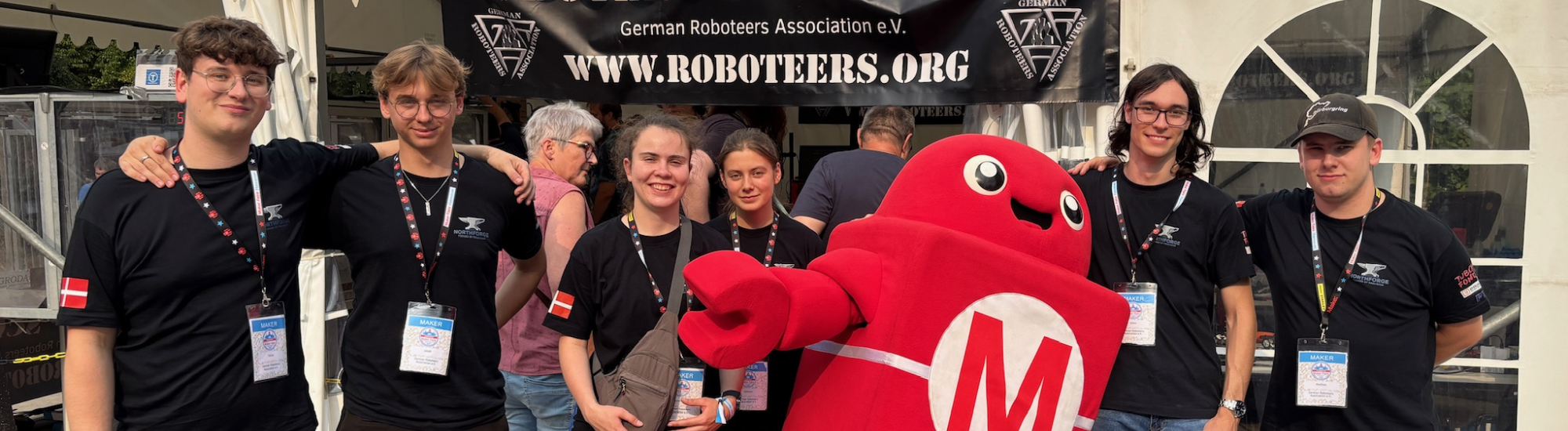
SDU students send robots into the battle arena
In just one year, a group of students at SDU have built a battle-ready robot, founded what is currently Denmark’s only BattleBots club and taken part in their first international competition. Along the way, they have discovered that lessons in materials, simulation and cooling become very tangible when a robot has to withstand a beating.
North Star 1 races across the floor and slams into its opponent. The impact sends the other robot into a corner of the arena, bringing the bout to an end.
That was how a group of engineering students from SDU secured one of their two victories when they recently took part in their first international robot combat competition in Hanover.
In other bouts, however, it was North Star 1 that took the beating. A serious beating. Parts of its structure were bent so badly that the students had to repair the robot using the spare parts they had brought with them. Fortunately, they had brought plenty.
“We had enough spare parts to build an entirely new robot if necessary. Luckily, it did not come to that. It was mainly the weapon that we had to repair,” says 24-year-old Tobias Lorenzen, who is in the fifth semester of his Mechatronics degree and is one of the founders of the North Forge club.
It began with online videos
The idea emerged around a year earlier, when Tobias watched videos of robot combat online. In the televised BattleBots competitions, remote-controlled robots fight one another inside an enclosed arena until one of them can no longer continue.
Tobias asked some friends on campus whether they would like to build something similar.
“I basically just said, ‘Why don’t we build something cool?’ We then spoke to some of our lecturers about who could help us establish a club. It grew gradually from there,” he says.
There were five students at the beginning. They first gathered some components and built a robot that could move. North Forge was subsequently approved as a student association, allowing the group to apply for funding and purchase the parts and materials needed to make the robot ready for battle.
The first prototype quickly revealed that enthusiasm alone would not be enough. The structure was too flimsy, friction caused problems, and several of the original solutions were unlikely to survive an encounter with another combat robot.
This marked the beginning of a lengthy process of building, testing, breaking and rebuilding.
“Our approach is very much to build something and then test whether it works. We carry out what we call ‘bash tests’, which basically means hitting things. At the same time, we use simulations to determine whether our solutions will hold. We then modify the design and repeat the process until we have something we believe will work,” says Tobias.
Putting their studies into practice
A combat robot in North Star 1’s weight class weighs just 1.5 kilograms. Despite its size, it places considerable demands on the design.
The robot must be light and fast while also being able to withstand violent impacts.
Its motors and electronics must be protected, heat must be dissipated, and every component must fit into a very confined space. Ideally, the robot should also be able to continue moving even if its weapon or other components are damaged.
This has required the students to draw on knowledge from several areas of their degree programme.
Their work has included materials selection, friction, cooling, structural design and impact simulation. Lessons in impact simulation helped them calculate what happens when the robots collide, while fluid mechanics proved useful when they needed to cool the motors.
“We have learnt that what we are taught actually makes sense and that we can use it in real life. You do not always experience that quite so directly,” says Tobias.
Arkadiusz J. Goszczak, Head of the Centre for Materials Analysis and Characterization, and Associate Professor Casper Høgh Kunstmann, both from SDU NanoSYD at the Mads Clausen Institute, have helped supervise the students together with colleagues.
Goszczak points out that the project forces the students to combine knowledge from several branches of engineering. It is not enough to build a small vehicle that can move. They must construct a robot capable of taking a heavy impact and continuing to fight.
“They are balancing a massive puzzle: choosing the right materials, figuring out how to join them and ensuring that the robot moves smoothly while maintaining its grip on the floor. On top of that, they have to power a weapon system and pack every single component into an incredibly tight space. It requires them to look at the big picture and truly engineer every detail in depth,” says Arkadiusz J. Goszczak.
According to the two supervisors, the first version was far from battle-ready.
“In the beginning, they were passionate young engineering students eager to create. Their first prototype had its flaws: it was rather fragile, and some of their ideas were not quite realistic. Arkadiusz had to give them a tough engineering reality check. But they did not back down. Since then, they have developed tremendously, transforming raw enthusiasm into deep engineering expertise. We are very proud of them,” says Casper Høgh Kunstmann.
The students have also received guidance from Jan Tiettje and Bo Atzen in SDU’s workshop, who helped deepen their understanding of materials and mechanical components. They also benefited from the expertise of lecturers such as Andrei Popa, who advised them on additive manufacturing.
Their proposed solutions have been challenged along the way, while experience from the aviation industry inspired them to experiment with aluminium sandwich structures.
Not every attempt worked as intended. One component that the simulations suggested should withstand the impacts was nevertheless bent during the competition in Hanover.
But it is precisely these failures that drive the development process forward.
“We think a great deal about redundancy. If something breaks, can the robot still move? Can it continue fighting and perhaps even win? There is a great deal of thought behind it,” says Tobias.

Denmark’s best – and only – team
North Forge won two of its five bouts at the competition in Hanover and finished a shared eighth out of 15.
This means that, with a twinkle in their eyes, the students can call themselves Denmark’s best BattleBots team. They are also the country’s only team.
The club is growing quickly, however. North Forge has expanded from its original five founders to nine active members, while 23 interested students applied to join at the beginning of the new semester.
The club now plans to let its new members begin by building robots for the antweight class. These robots weigh just 150 grams and are cheaper and more accessible to build than North Star 1. At the same time, the experienced members are working on another robot in the 1.5-kilogram class, enabling North Forge to enter two larger robots in a future competition.
Even a small combat robot comes at a cost. According to Tobias, building a robot in North Star 1’s class costs approximately DKK 5,000. The weapon is particularly expensive because it requires materials that are both hard and capable of withstanding powerful impacts without breaking.
Dreaming of a Danish arena
In the longer term, North Forge hopes to establish an enclosed combat arena at SDU. The club has already made contact with robot builders from other countries who have expressed an interest in coming to Denmark if a competition is organised.
A Danish arena could also allow other universities and schools to build robots and face one another in competition.
The project could therefore grow from a student idea into a new hub for practical engineering.
For Tobias, BattleBots is a competition, but it is also an opportunity to search constantly for the small improvements that can make the difference between victory and having to carry a broken robot out of the arena.
His actual ambition is to work in Formula One. For now, however, the small combat robots allow him to work with many of the same elements: speed, materials, marginal gains and uncompromising development.
“It is great fun and highly competitive. You are constantly trying to gain even the smallest advantage through your design,” he says.
And if the calculations prove too optimistic, the arena delivers a very direct answer.