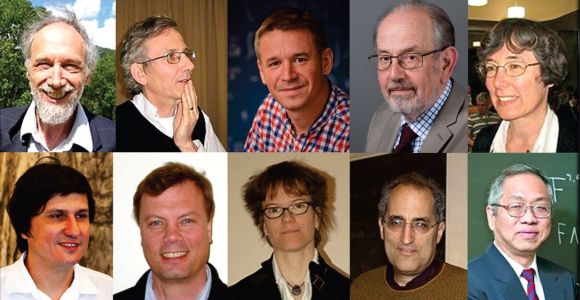
Our mission is to advance research and education in quantum mathematics – the mathematical language underlying quantum theory and future quantum technologies. The Centre for Quantum Mathematics (QM) at the University of Southern Denmark (SDU) was established in 2019 to address one of the most profound challenges in modern science: building a mathematically precise foundation for quantum theory.
At QM, researchers work at the interface of mathematics and quantum science, developing both fundamental theory and applications with direct relevance to quantum computing and quantum software. While quantum computers are rapidly becoming a reality and are expected to revolutionize technology across all sectors, major gaps remain in our theoretical understanding. Fully harnessing the power of quantum technologies requires deeper insight into the quantum structure of the universe—and that insight must be grounded in rigorous mathematics.
Led by Professor Jørgen Ellegaard Andersen, QM holds a unique position in the global quantum landscape. The centre combines exceptional theoretical expertise with a strong international research network and outstanding funding. With simultaneous support from one of Europe’s largest research grants and one of the largest US research grants, QM has strong momentum to shape the future of quantum science. Through foundational research, education, and international collaboration, the centre is committed to unlocking the full potential of the quantum revolution.
Organisation
The Centre for Quantum Mathematics is a part of the section at the Department of Mathematics and Computer Science.
We are affilliated to the Danish Institute for Advanced Study, as Centre Director Jørgen Ellegaard Andersen has been appointed DIAS Chair of Quantum Mathematics.
Research projects
QM is involved in several research projects funded from both Danish, European and American – private and governmental funds.
Quantum Centre of Excellence (QEX)
Principal Investigator: Jørgen Ellegaard Andersen
Period: 2025–2029
Funding: €10 million
Project Details
QM serves as the scientific lead of QEX, with administrative coordination by Quantum Delta NL (QDNL). The consortium includes partners from Denmark, the Netherlands, Germany, Spain, and Ireland.
The €10 million grant is funded 50% by EU Horizon / EuroHPC Joint Undertaking and 50% by DeiC. One third of the funding is allocated to Denmark, involving University of Copenhagen (KU), Technical University of Denmark (DTU), and University of Southern Denmark (SDU/QM). QM also acts as the Danish national coordinator.
Description
QEX is a European Quantum Centre of Excellence aimed at strengthening Europe’s leadership in quantum technologies. The centre advances cutting‑edge research, innovation, and applications in quantum computing, spanning foundational theory, quantum software, algorithms, and real‑world industrial use cases.
Links
https://quantumdelta.nl/qex
https://www.sdu.dk/en/forskning/qm/news/qex
https://www.eurohpc-ju.europa.eu/qex-european-quantum-excellence-centre-drive-innovation-and-applications-2025-11-12_en
Recursive and Exact New Quantum Theory (ReNewQuantum)
Principal Investigator: Jørgen Ellegaard Andersen
Period: 2023–2029
Funding: €10 million
Project Details
The project is supported by an ERC Synergy Grant and is conducted in collaboration with:
- Maxim Kontsevich (Institut des Hautes Études Scientifiques),
- Marcos Mariño (University of Geneva), and
- Bertrand Eynard (Institut de Physique Théorique, CEA Saclay).
Description
'Recursive and Exact New Quantum Theory' is based on advanced geometric and topological constructions. The Pi’s are building a new approach to Quantum Theory - providing explicit recursive schemes which compute effectively quantum corrections to all orders and obtain exact results using all non-perturbative contributions.
Links
https://renewquantum.eu/
New Structures in Low‑Dimensional Topology
Principal Investigator: Jørgen Ellegaard Andersen
Period: 2023–2029
Funding: USD 12 million
Project Details
The project is funded by a Simons Foundation Collaboration Grant and involves researchers from leading institutions including Princeton, Harvard, Stanford, Caltech, MIT, UCLA, Columbia Univ., Univ. Zurich, USC
“The fact that SDU has a mathematician of such caliber who can achieve both the largest and most prestigious grant in Europe and in the United States at the same time is truly world‑class and a clear expression of research excellence.”
– Jens Ringsmose, Rector, University of Southern Denmark
Description
This project explores new structures in low‑dimensional topology and their deep connections to quantum field theory, representation theory, and mathematical physics. It develops novel theoretical frameworks with impact across both fundamental mathematics and quantum physics.
Links
https://www.sdu.dk/en/forskning/qm/news/simons-foundation
https://sites.google.com/view/simons-newstructures/home
Topological Photonic Quantum Computing and its Applications – (TopQC2X)
Principal Investigator: Jørgen Ellegaard Andersen
Partners: SDU, DTU
Period: 2023–2029
Funding: DKK 23.7 million
Project Details
Innovation Fund Denmark invests in the development of a topological fault tolerant quantum computer
SDU leads theoretical research, while DTU leads the development of experimental hardware focused on Topological Photonic Quantum Computing and its applications
Description
The vision of TopQC2X is to realize a scalable, universal, fault‑tolerant topological quantum computer with certified quantum advantage in solving real‑world problems.
Links
https://www.sdu.dk/en/forskning/qm/topqc2x
https://www.sdu.dk/en/forskning/qm/news/topqc2x
Mathematics of the Topological Open String
VILLUM Investigator: Vivek Shende (PI)
Period: 2021–2027
Funding: DKK 25 million
Description
This project develops foundational mathematics inspired by topological string theory, particularly the topological open string. It sits at the interface of geometry, topology, and theoretical physics.
Links
https://www.sdu.dk/en/forskning/qm/news/villum_investigator
https://dg.dk/en/three-researchers-with-affiliation-with-the-dnrf-each-receive-a-villum-investigator-grant/
The Quantum Geometry of Dynamical Systems
VILLUM Ascending Investigator: Fabian Haiden (PI)
Period: 2026–2030
Funding: DKK 18.2 million
Description
The project addresses fundamental challenges in mathematics and theoretical physics by combining quantum geometry and dynamical systems. It also connects to applied questions such as electron transport in materials, with relevance for energy‑efficient technologies, and explores deep structures of space including black hole entropy.
Link
https://www.sdu.dk/en/forskning/qm/news/faibian-haiden-villum-fond-bevilling-2026
New Invariants in Low‑Dimensional Topology via Quantum Field Theory
VILLUM Young Investigator: Du Pei (PI)
Period: 2022–2027
Funding: DKK 6 million
Description
The project deepens the connection between geometry and physics by studying three‑ and four‑dimensional spaces using quantum field theory and string theory. It develops new mathematical invariants and tools while providing insights into quantum phases of matter, string theory, quantum gravity, and quantum computation.
Links
https://www.sdu.dk/en/forskning/qm/news/du-pei
https://villumfonden.dk/en/projekt/new-invariants-low-dimensional-topology-quantum-field-theory
Thermodynamics of Strongly Coupled Quantum Field Theories
VILLUM Young Investigator: Matthias Wilhelm (PI)
Description
The grant is formally held at the University of Copenhagen and carried out at SDU through a collaboration agreement. The project develops new theoretical methods to understand the thermodynamics of strongly coupled quantum field theories, with a focus on the quark‑gluon plasma and its transition into ordinary matter in the early universe. Because the underlying theory, Quantum Chromodynamics, cannot be analyzed with traditional approaches, the research aims to create new tools to study these extreme states of matter.
Global Categorical Symmetries and Phases of Quantum Matter
VILLUM Young Investigator: Apoorv Tiwari (PI)
Period: 2023–2028
Funding: DKK 8,9 million
Description
Symmetries play a fundamental role in the quantum world. Recent years have seen a paradigm shift in the understanding of symmetries, unraveling new and vastly generalized symmetries known as global categorical symmetries. This project aims to advance the understanding of symmetry in quantum systems and explore its implications for quantum matter. The grant will fund two Ph.D. students and one postdoc.
The DNRF Chair
Principal Investigator: Vivek Shende
Period: 2021–2024
Funding: DKK 8 million
Description
The DNRF Chair funded by the Danish National Research Foundation supports the establishment of an international research environment around pioneering mathematics at the interface with physics.
Link
Applications of knot invariants/microlocal sheaf theory in macromolecular folding/topological data analysis applicable to biomedicine
Novo Nordisk Foundation Starting Package: Vivek Shende (PI)
Period: 2021–2025
Funding: DKK 6 million
Description
The project applies topological invariants and microlocal sheaf theory to problems in macromolecular folding and topological data analysis with biomedical relevance.
CLUSTEC
EU-HORIZON-DIGITAL-EMERGING grant: Jørgen Ellegaard Andersen (PI)
Period: 2022–2026
Funding: EUR 2,994,544
Description
QM collaborates with DTU and several leading institutions in the EU-funded CLUSTEC project. The project combines quantum mathematics and photonic quantum technologies to address key challenges in scalability and fault‑tolerant quantum architectures and is carried out by an international European consortium coordinated in Denmark.
Links
https://www.sdu.dk/en/forskning/qm/quantum-computing/clustec
https://cordis.europa.eu/project/id/101080173
QCI.DK – Danish Quantum Communication Infrastructure
EU Digital grant: Jørgen Ellegaard Andersen (PI)
Period: 2023–2026
Funding: EUR 3,003,206
Description
QCI.DK establishes the national Danish quantum communication infrastructure as part of the European Quantum Communication Infrastructure initiative. In addition, the infrastructure will encompass a 200 km long-distance link between Odense and Copenhagen connecting three participating university partners (SDU, DTU and University of Copenhagen) via the metropolitan network.
Link
https://www.sdu.dk/en/forskning/qm/quantum-computing/danish-qc-infrastructure
The Emergent Geometry of Categories
DFF Sapere Aude: Fabian Haiden (PI)
Period: 2024–2028
Funding: DKK 6 million
Description
The project is about developing this mathematical dictionary for a novel algebraic structure called a category. These are used, for example, in the design of robust programming languages, to work out predictions of physical theories, or to understand large language models. The goal of the project is to develop the mathematical tools necessary to answer questions like: What is the origin of space-time in physics? How can we visualize, what is happening inside a neural network?
Leveraging Algebraic Geometry for High-Precision Fundamental Physics
DFF Sapere Aude: Matthias Wilhelm (PI)
Period: 2024-2028
Funding: DKK 6 million
Description
The project aims to advance our understanding of fundamental physics by developing highly precise theoretical predictions that can be tested against cutting‑edge experiments. By comparing theory and experiment at unprecedented accuracy, the project seeks to uncover signs of new physics beyond the Standard Model and general relativity, particularly in data from the Large Hadron Collider and gravitational‑wave observations of black holes and neutron stars.
Link
From Perturbative to non-perturbative quantum field theory by cutting and gluing
DFF Sapere Aude: Konstantin Wernli (PI)
Period: 2024-2028
Funding: DKK 6 million
Description
This project aims to bridge perturbative and non‑perturbative approaches to quantum field theory by developing a new framework for cutting and gluing Feynman graphs. By studying this connection on simple spacetime building blocks, the project seeks to deepen our understanding of quantum interactions and spacetime structure at the smallest scales, paving the way for new theoretical insights and discoveries.
Link
Quantum Programming Beyond the Circuit Model
DFF Sapere Aude: Robin Kaarsgaard Sales
Period: 2026-2030
Funding: DKK 6,2 million
Description
Quantum computing has the potential to transform fields like cybersecurity, optimization, and the simulation of physical systems. Realizing this promise requires better programming languages than those currently available, which often resemble the low-level languages of early classical computing and demand deep expert knowledge. This research project aims to develop modern quantum programming languages that let users express computations at a high, conceptual level, making quantum computing more accessible and powerful.
Quantum Computing 2 Business (QC2B)
Principal Investigator: Jørgen Ellegaard Andersen
Period: 2025–2027
Funding: DKK 2,5 million
Description
QC2B connects cutting‑edge quantum research with concrete business and industry needs. It is a Quantum Competence grant funded by Danish e-Infrastructure Consortium (DeiC).
Link
https://www.sdu.dk/en/forskning/qm/qc2b
Towards improved weather and climate predictions via quantum computing
DeiC - Quantum Postdoc Fellowship: Gard Olav Helle(PI)
Period: 2024-2027
Funding: DKK 3,2 million
Description
The project develops and tests quantum algorithms for weather and climate prediction, in close collaboration with experts from the Danish Meteorological Institute. A key goal is to identify numerical methods suitable for quantum computers and to enable simulation of the shallow water equations, a central benchmark in weather forecasting. The project also explores theoretical approaches based on the Madelung transform, which reformulates fluid dynamics equations as a Schrödinger equation.
Estimating Gaussian Expectation Problems with Gaussian Boson Samplers (GBS2EXP)
DeiC - Quantum Postdoc Fellowship: Olga Solodovnikova (PI)
Period: 2024-2027
Funding: DKK 2,2 million
Description
GBS2EXP aims to use Gaussian Boson Samplers—current noisy quantum devices—to estimate high‑dimensional, Gaussian‑weighted integrals more efficiently than classical Monte Carlo methods. By developing algorithms tailored to realistic, lossy GBS hardware, the project seeks a first industry‑relevant application of GBS with impact in finance and beyond.
The Algorithms, Advantage and Applications of Gaussian Boson Sampling
DeiC – Quantum PhD Fellowship: Jørgen Ellegaard Andersen (PI)
Period: 2025-2028
Funding: DKK 2,7 million
Description
Gaussian Boson Sampling (GBS) is a photonic quantum computing approach that can solve Gaussian expectation problems more efficiently than classical Monte Carlo methods, making it promising for near-term quantum advantage. This project aims to make GBS practically useful by developing noise‑resilient algorithms, extending GBS methods to other quantum platforms, and demonstrating real-world use cases across different hardware, bridging theory and practical quantum applications.
Collaboration partners
We collaborate closely with several leading universities and research centre around the world, including in particular IHES, Geneva University, Princeton, Harvard, Stanford, MIT, Caltech, UCLA, USC, Danmarks Tekniske Universitet (DTU), Univerzita Palackho V Olomouci, Ruprecht-Karls-Universität Heidelberg, Q.ANT GMBH, Johannes Gutenberg-Universität Mainz, Sorbonne Universite, Centre Suisse d’Electronique et de Microtechnique SA., UC Berkeley.
Futhermore, the centre collaborates closely with the SDU Climate Cluster.
Spin-out
The company Qpurpose brings together academic and industrial partners to test advanced quantum algorithms and quantum software on state‑of‑the‑art quantum hardware.
Qpurpose was founded by Jørgen Ellegaard Andersen in 2022.