I wanted a slightly gentler start to working life
A good transition from study to work mattered to Kamilla, and she found that at BEC Financial Technologies, which offers graduates a 1-year graduate programme.
You invest many hours and a great deal of energy in your studies, so you should choose something you care deeply about and want to explore in depth. That is Kamilla Kaminsky Lintrup’s advice to prospective students, and it is also how she chose her own degree.
“I also considered engineering. It was more concrete, but I liked the broader nature of Physics. And I had a physics teacher in upper secondary school who was incredibly passionate and a good teacher. It really sparked my interest that, through physics, I could explore things I did not understand,” says Kamilla.
But “no one looks for a physicist in job adverts”, she also says, and as her time as a student went on, she began to worry a little about what job might be waiting for her after graduation.
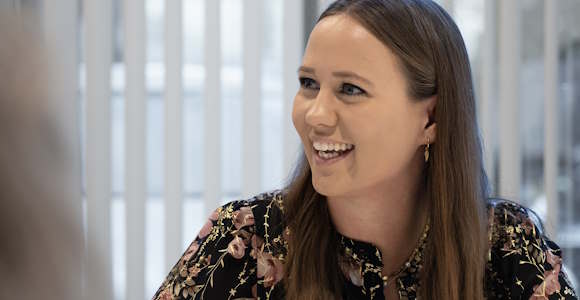
“Physics makes you so versatile that you can apply for an incredible number of positions, and that was actually a bit hard to take in while I was studying. But now I have found the right place.”
Kamilla’s job title today is software engineer at BEC Financial Technologies, where she has worked since she graduated.
“I wanted a graduate programme when I was about to apply for my first job, and BEC offered that.”
The graduate programme at BEC lasts 1 year and offers, among other things, a mentor who guides recent graduates through their first period in the company. You take courses along the way, and there are often social events with other graduates too.
We were 25 graduates
“We were 25 graduates when I started, and for example we went to Poland together, where BEC has one of its locations. A graduate programme is a perfect transition between university and work. It gives you a slightly softer start to working life, and it is exciting that a company wants to invest in you.”
As a software engineer at BEC, Kamilla works with managing customer data for the banks and financial institutions that BEC handles IT tasks for.
“We have responsibility for a huge system, and that is exciting. Society simply does not function if the banks go down, and my area, customer data, is so central that many people here in the company depend on our team. I am fascinated by the large-scale setups we work with.”
”I was deeply fascinated by particle physics and astrophysics!
There is not much concrete physics in her working day, Kamilla admits – instead, she draws on the analytical mindset and the ability to understand complex problems that she developed during her studies.
“It is the same approach as when you describe a physical problem.”
Kamilla is quite happy not to work with physics’ heavy equations in her professional life, but she does sometimes miss diving a little deeper into physics. That is why she reads books about physics, and she is happy to travel to Finland to see the Northern Lights.
“The next book I am going to read is “The Greatest Story Ever Told So Far”. It describes the universe through physics, and I am looking forward to it.”
Summer school at La Palma
Kamilla went straight from upper secondary school to university.
“I have thought about education since I was very young. At the start of upper secondary school, I was unsure whether to choose the languages route or the science route, so I chose a track where I had both at a high level. When I became interested in physics and chose to study it at university, it was great to be able to immerse myself in it. I was really fascinated by particle physics and astrophysics! Among other things, I spent a couple of weeks at a summer school at the Nordic Optical Telescope on La Palma.”
But Kamilla was also interested in exploring other areas of physics – preferably some that were more in demand on the job market than particle physics – and that is why she threw herself into statistics and data processing during her master’s degree. She took mathematics as a minor subject, both because it is a good complement to physics and because it also gave her the opportunity to become an upper secondary school teacher.
“I am quite sure I would enjoy that. But now I am a software engineer, which I find incredibly exciting, and I am happy to be here. I have taken courses in, among other things, programming and banking, and I like that my working day is so varied.”