Integrated Technology Workflow
Advanced Quantitative Proteomics
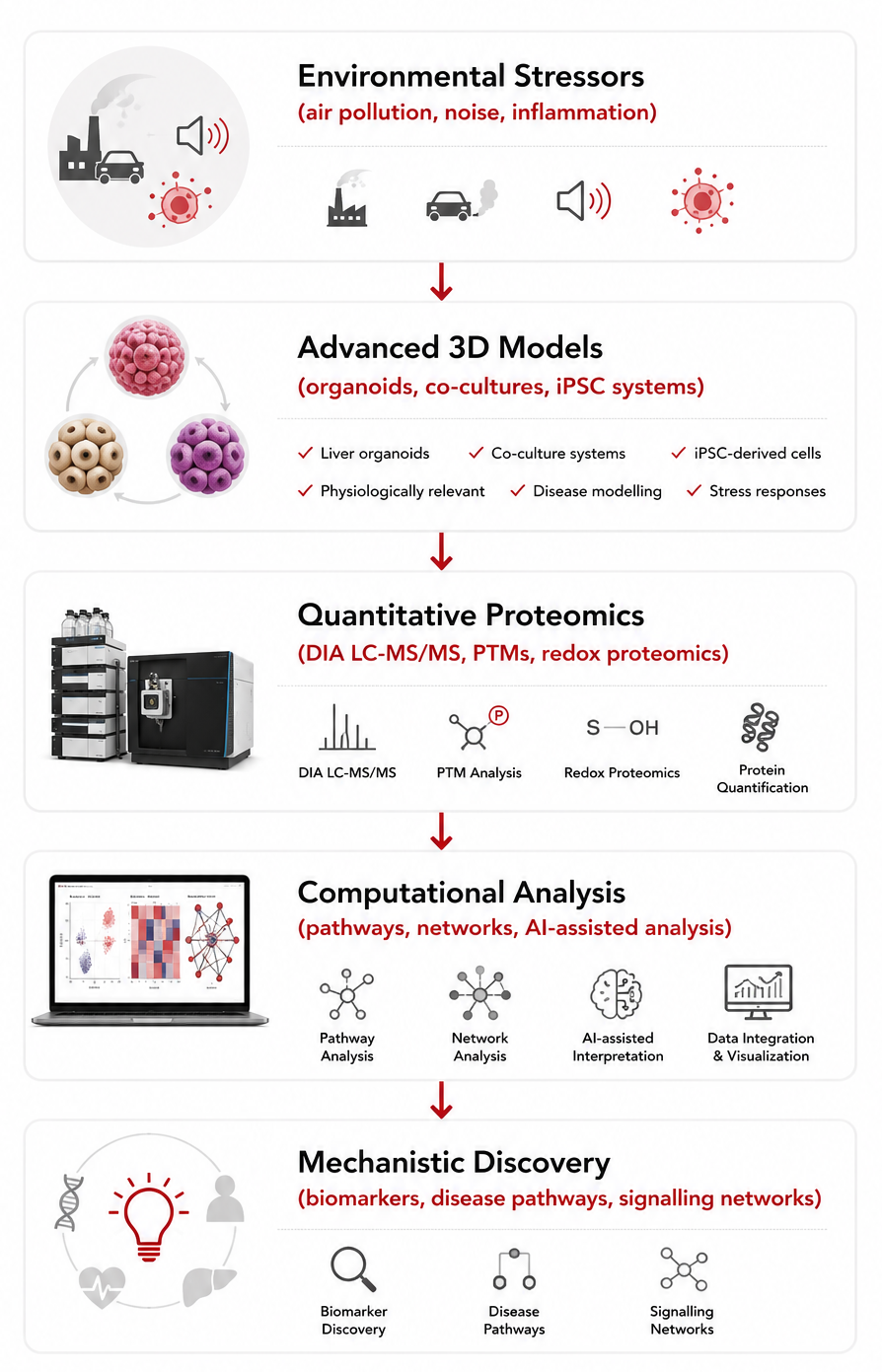
We use high-throughput data-independent acquisition (DIA) proteomics for quantitative analysis of complex biological systems. Our workflows integrate automated sample preparation, Orbitrap-based mass spectrometry, and advanced bioinformatics to quantify thousands of proteins with high reproducibility and analytical depth.
Our expertise includes:
- DIA proteomics
- Redox proteomics
- Post-translational modification analysis
- Phosphoproteomics
- Secretome analysis
- Pathway and network analysis
3D Disease Models & Organoids
We develop advanced 3D cellular systems to model biologically relevant tissue responses under controlled experimental conditions. These models enable mechanistic investigations that better reflect physiological organisation and stress adaptation compared to conventional 2D cultures.
Current applications include:
- Liver fibrosis
- Metabolic dysfunction
- Oxidative stress
- Environmental exposure
- Cell-cell communication
- Ageing-associated processes
Imaging & Cellular Analysis
Advanced imaging approaches are integrated with proteomics and molecular biology workflows to characterise structural and functional cellular responses. We combine confocal microscopy, immunostaining, cryosectioning, and quantitative image analysis to study cellular organisation, stress responses, and tissue architecture in 3D systems.
Computational Biology & Bioinformatics
Large-scale omics datasets are analysed using advanced computational workflows for quantitative interpretation of biological systems. Our approaches include statistical modelling, pathway enrichment, protein complex analysis, and network-based data integration.
We also contribute to the development of computational tools for omics data interpretation and visualisation.
Environmental Stress Biology
A major focus of our research is understanding how chronic environmental stressors influence molecular signalling networks and disease-associated pathways. We investigate the biological effects of air pollution, noise exposure, inflammation, and oxidative stress across interconnected organ systems using integrated experimental and computational approaches.
Technologies overview grid
| Platform | Technologies |
|---|---|
| Proteomics | DIA LC-MS/MS, Orbitrap Astral, PTM analysis |
| Cell models | Organoids, spheroids, co-cultures, iPSC systems |
| Imaging | Confocal microscopy, immunostaining, cryosectioning |
| Bioinformatics | Pathway analysis, network biology, AI-assisted analysis |
| Molecular biology | Protein analysis, stress-response assays |
| Environmental biology | Exposure models, systems-level stress analysis |