Advancing Organoid Technologies for Liver Tissue Engineering and Disease Modelling
We develop and utilise liver organoids—three-dimensional models of human liver tissue grown in the lab—to mimic organ development, disease processes, and therapeutic responses in a controlled environment. Our research focuses on using these 3D multicellular constructs, derived from stem cells or primary cells, to investigate liver physiology, pathology, and regeneration, with a particular emphasis on conditions such as fibrosis and fatty liver disease. By studying fatty liver disease, we aim to better understand its links to metabolic disorders and associated cardiovascular diseases. By integrating advanced quantitative proteomics, we uncover molecular pathways involved in liver diseases, optimise extracellular matrix and cellular niche conditions, and enhance the translational potential of organoids for therapeutic discovery.
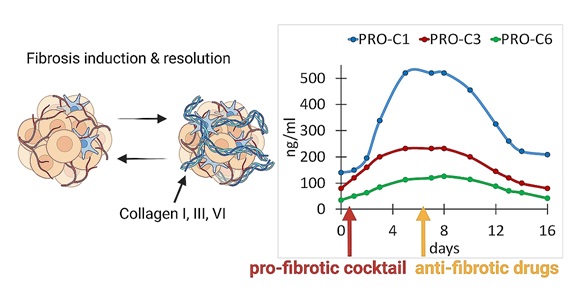
This image illustrates the process of fibrosis induction and resolution in a 3D liver model. The schematic on the left shows the extracellular matrix (ECM) deposition, particularly Collagen I, III, and VI, during fibrosis progression and its subsequent resolution. The graph on the right quantifies the levels of fibrosis markers (PRO-C1, PRO-C3, and PRO-C6) over time, highlighting the impact of a pro-fibrotic cocktail at day 0 and anti-fibrotic drug treatment from day 8 onwards. This model demonstrates the dynamic changes in ECM composition and provides insights into therapeutic interventions for liver fibrosis.
People working in this research area:
Mie (PhD) works on differentiating primary stem cells to mature hepatocytes in 3D cultures in collaboration with Celvivo, and Karoline (PhD) works on a clinostat-based system to improve in vitro liver fibrosis models and therapeutic testing in collaboration with Celvivo
Related publications:
Charlet-Faure C, Thulesen AP, Rogowska-Wrzesinska A. Advancements in 3D spheroid imaging: Optimised cryosectioning and immunostaining techniques. MethodsX. 2023 Dec;11:102415. DOI: 10.1016/j.mex.2023.102415
Frandsen HS, Vej-Nielsen JM, Smith LE, Sun L, Mikkelsen KL, Thulesen AP Hagensen, CE, Yang, F & Rogowska-Wrzesinska, A. Mapping proteome and lipidome changes in early-onset non-alcoholic fatty liver disease using hepatic 3D spheroids. Cells. 2022 Oct;11(20):3216. DOI: 10.3390/cells11203216
Vej-Nielsen JM, Rogowska-Wrzesinska A. 3D-ViaFlow: A Quantitative Viability Assay for Multicellular Spheroids. In Brevini TAL, Fazeli A, Turksen K, editors, Next Generation Culture Platforms for Reliable In Vitro Models: Methods and Protocols. Humana Press. 2021. p. 159-171. (Methods in Molecular Biology, Vol. 2273). DOI: 10.1007/978-1-0716-1246-0_11