Ny podcast-serie: Hans Christian Andersen: Fairy Tales, Technology, and the Natural Sciences
Lyt med, når fire af centrets forskere tager dig med ind i tre af H.C. Andersens mindre kendte værker - inspireret af videnskab, opfindelser og nysgerrighed
Denne podcast i tre episoder udforsker forbindelserne mellem en af verdens mest elskede historiefortællere og de videnskabelige og teknologiske revolutioner i det 19. århundrede. Mads Sohl Jessen er vært for serien, som dykker ned i tre af Andersens mindre kendte fortællinger—værker inspireret af hans venskaber med videnskabsfolk, hans fascination af banebrydende opfindelser og hans engagement i naturvidenskaben.
Mens Andersens ikoniske eventyr som Den lille havfrue, Den grimme ælling og Snedronningen fortsat tryllebinder publikum verden over, afslører denne podcast tre litterære perler, der viser, hvordan Andersen flettede videnskab og teknologi ind i sin fortællekunst. Følg Mads og tre af hans kolleger fra H.C. Andersen Centret, når de undersøger, hvordan Andersens nysgerrighed på verden omkring ham formede hans eventyr—og hvorfor disse historier er lige så relevante i dag som dengang.
Podcast-serien er perfekt for alle med en interesse i litteratur, videnskabshistorie og som er nysgerrige på forbindelserne mellem litterær kunst og teknologisk innovation.
Seriens afsnit
In this episode, Mads Sohl Jessen and Holger Berg explore Andersen’s 1869 story "The Comet"—a poetic meditation on time, science, and human wonder. From the story’s publication in an American journal to its portrayal of a boy who as an old man witnesses the same comet decades apart, they discuss how Andersen fuses astronomy, superstition, and faith. Discover how this tale reflects Andersen’s lifelong fascination with science, and his belief in the immortality of the human soul.
Key moments:
Andersen’s cosmic imagination, the science of comets, and the story’s moving finale.
Suggested reading:
Hans Christian Andersen: The Comet
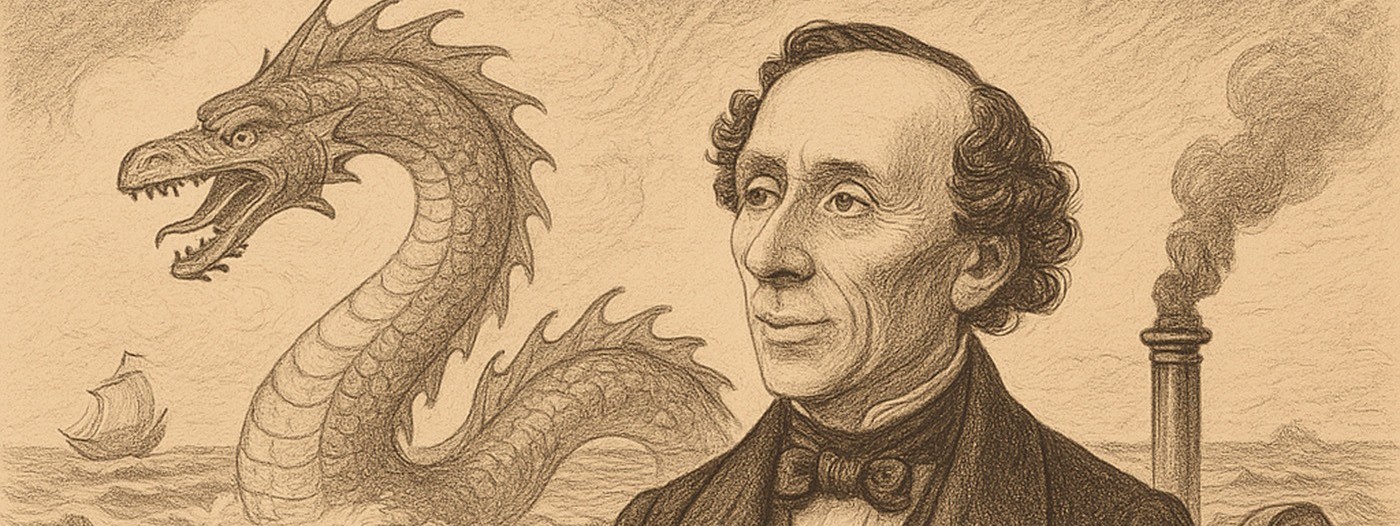
In this episode, Mads Sohl Jessen and Ane Grum-Schwensen discuss Andersen’s 1871 tale "The Great Sea Serpent—a modern fairy tale" that explores the ecological and technological upheaval caused by the transatlantic telegraph cable. From Andersen’s vivid descriptions of marine life disrupted by human invention to his use of scientific literature, they discuss how Andersen blends myth, science, and empathy. Discover why this story, told from the perspective of a curious little fish, remains a poignant reflection on humanity’s impact on nature.
Key moments:
Andersen’s ecological themes, the story’s mythological twist, and its modern characteristics.
Suggested reading:
Hans Christian Andersen: The Great Sea Serpent
For further reading on Hans Christian Andersen in ecocritical analyses – and for a closer look at the analysis that forms the basis of the podcast’s reading of The Great Sea Serpent – see Torsten Bøgh Thomsen, Skyggepunkter (Shadow Points), Forlaget Spring, 2019.
For further details on the making of this tale, see the Danish introduction in the ongoing manuscript edition: Ane Grum-Schwensen. ”Tilblivelsen af ’Den store Søslange’” (2025)
In this episode, Mads Sohl Jessen and Torsten Bøgh Thomsen talk about Andersen’s 1852 tale "Thousands of Years from Now"—a strikingly modern vision of mass tourism, technological progress, and cultural decline. Andersen imagines a future where Americans traverse the Atlantic by airship, visiting the ruins of Europe’s once-great cities. From the decay of Rome to the Channel Tunnel between England and France and the rise of American dominance, they discuss Andersen’s prescient critique of modernity, his reflections on the fragility of culture, and the tale’s relevance today.
Key points:
Andersen’s futuristic Europe, cultural decline, and the power dynamics between the US and Europe.
Suggested reading:
Hans Christian Andersen: Thousands of Years from Now
For further details on the making of this tale, see the Danish introduction in the ongoing manuscript edition: Mads Sohl Jessen. ”Tilblivelsen af ’Om Aartusinder’” (2025)
Denne podcast er støttet af Kulturministeriet