When disagreement turns into polarisation
The Nordic Humanities Centre put polarisation on the agenda at Folkemødet 2026 through debates and workshops that offered the audience new perspectives on hate speech and conspiracy theories. The researchers demonstrated how research in the humanities can help to understand and mitigate the conflicts that are increasingly characterising public debate.
- One might argue that there are already plenty of conspiracy theories to choose from, but we need to get inside the engine room and understand the logics behind them. It is important for the cohesion of democracy that we are also able to engage in dialogue with people who believe in conspiracy theories,” says Kasper Grotle Rasmussen, who has researched the subject for many years.
The logic of conspiracy theories
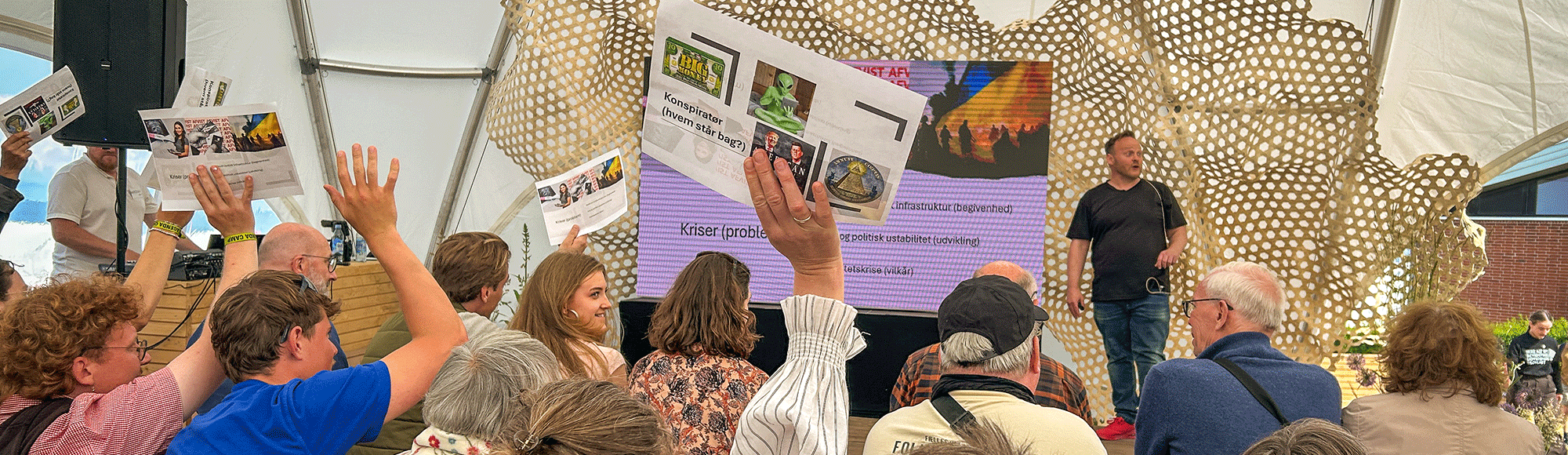
Under the tent canopy and with a view of the Baltic Sea, participants gained insight into how major crises often serve as a breeding ground for conspiracy theories, and how the assumption that an elite of powerful capitalists is secretly working behind the scenes and controlling our health, finances, and security is a recurring feature.Video from Folkemødet 2026

Kasper Grotle Rasmussen, Associate Professor of American Studies, explains the logic behind conspiracy theories.
”We need to get inside the engine room and become aware of the logics behind conspiracy theories.
- “If a theory cannot move beyond its own conclusion—if it is so locked into its own premise that it cannot be influenced by scientifically established evidence—then there is a high likelihood that it rests on a very weak knowledge base,” says Kasper Grotle Rasmussen, who emphasizes that transparency in society’s power structures and decision-making processes is important in order not to create fertile ground for conspiracy theorists.
Threats and hate speech
At the University of Copenhagen’s stage, center director Anders Engberg-Pedersen moderated a debate on polarization featuring Professor of Moral Philosophy Anne-Marie Søndergaard Christensen, Professor of Danish Language Tanya Karoli Christensen, and Associate Professor Kasper Grotle Rasmussen.

Here, the researchers put into words how polarization is expressed in language and in public debate. Tanya Karoli Christensen, who has studied the language of threats and hate speech and conducted linguistic analyses for the police, pointed out, among other things, how small linguistic markers such as the word “they” can help create distance and sustain conflict between groups.
The worst slurs
She also gave examples from the extreme end of the linguistic spectrum, where dehumanization is used as a strategy.
- This can include insults such as ‘they are cockroaches,’ ‘they are a cancer,’ or ‘they are a tsunami’ sweeping over us — deeply negative ways of describing another group, says Tanya Karoli Christensen.
”This may include insults such as “they are cockroaches.”
And it is precisely when we stop discussing the issue and instead start pointing fingers at each other that all constructive debate comes to an end. Professor of Moral Philosophy Anne-Marie Søndergaard Christensen used the example of the heated discussion about whether wolves have a place in Denmark.
- We tend to moralize about the societal issues that we consider important to us, and that is perfectly fine. That is what one should do in a democracy,” she says, adding that it is when the focus shifts away from the issue itself and we instead moralize and judge one another that things start to fall apart.
”We tend to moralize about the societal issues that we consider important to us, and that is perfectly fine.
For example, the debate fails when the discussion about wolves, instead of focusing on children’s sense of safety or biodiversity, turns into talk about “hypocritical Copenhagen snobs” or “trigger-happy Jutlanders who don’t care about nature,” as Søndergaard Christensen puts it.
That is also what is known as “affective polarization.”
- Participation in the Folkemødet is part of the research project "I en splittet tid: Polarisering i Danmark og Norden”, in which an interdisciplinary team of researchers in 2026 is examining how polarization arises—and how it can be countered through new knowledge and better dialogue.
Upcoming events
-
It will take place from August 20–22.
-
Read more about the Culture Meeting here.
Moral philosophy and polarisation

Anne-Marie Søndergaard Christensen, Professor of Moral Philosophy, and Tanya Karoli Christensen, Professor of Danish Language, on polarisation and hate speech.