When language divides: Polarisation, hate speech and conspiracy theories
What happens to democracy when language becomes toxic and threatening? What are some examples in Denmark and the Nordics of disagreement turning into outright hostility? And can news media do more to build bridges in society? These are some of the fundamental questions that a new group of fellows at the Nordic Humanities Centre will be working on in 2026.
- It is core humanistic material to investigate the human motivation behind, for example, very hateful comments towards other groups. If we are to counter the polarisation in society that we are beginning to see signs of, we must first get to the bottom of what drives anger and the desire to moralise and shame," says Tanya Karoli Christensen, professor of Danish language at the University of Copenhagen.
Chainsaw rhetoric
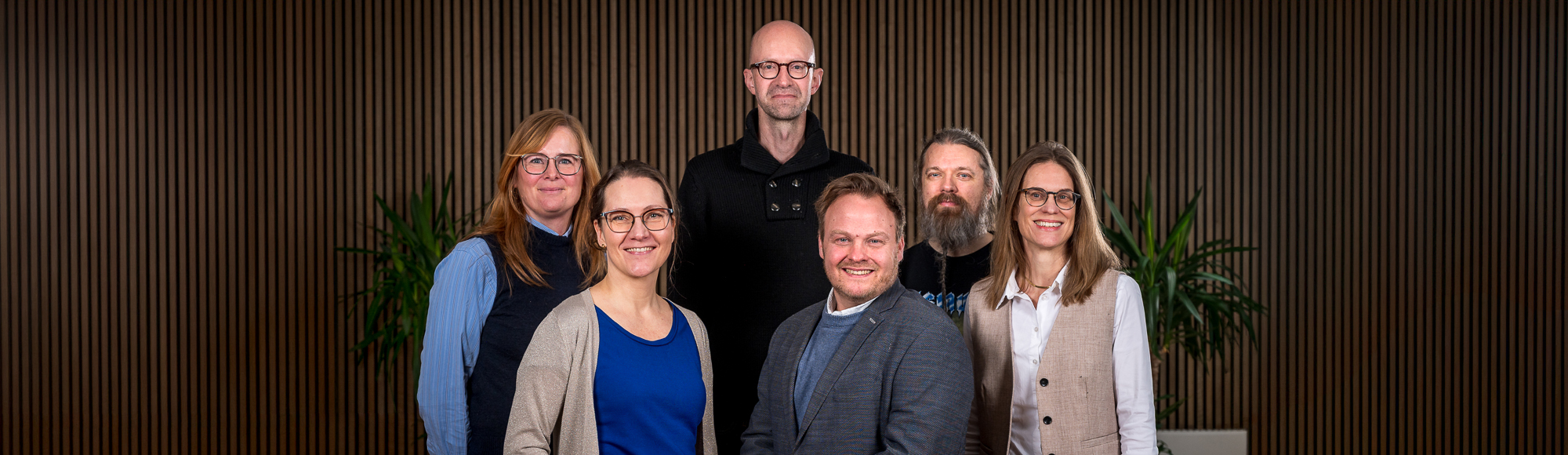
Together with Kathrin Maurer, professor of culture and technology at the University of Southern Denmark, she is heading the project entitled "In a divided time: Polarisation in Denmark and the Nordic countries". The group includes a total of six researchers with expertise in history, media studies, moral philosophy, English, linguistics, art and aesthetics.Fellows in 2026

Anne-Marie Søndergaard Christensen, Professor of Moral Philosophy, SDU • Tanya Karoli Christensen, Professor of Danish, UCPH • Anders Engberg-Pedersen, Head of Centre, NHC • Kasper Grotle Rasmussen, Associate Professor of American Studies, SDU • Kim Ebbensgaard Jensen, Associate Professor of English Linguistics, UCPH • Kathrin Maurer, Professor of Culture and Technology, SDU • Line Nybro Jensen, Associate Professor of Media Studies, UCPH (not in picture)
”It is core humanities subject matter to investigate what human motivation lies behind very hateful comments, for example
- I think the image of tech billionaire Elon Musk wielding a chainsaw at a conference to emphasise his dislike of bureaucracy is a very telling symbol of our time, says Kathrin Maurer, who has studied and lectured at universities in the US for a number of years.
- Brutal and destructive rhetoric is a way to win the battle for attention, and with our research we want to help counteract this development, she says.
Distance between us
Denmark is not where the US is when it comes to polarisation and division in society. This is the conclusion of a 2022 report from VIVE, the Danish National Centre for Welfare Research and Analysis.
This does not mean that polarisation trends have not reached this point. This is evident in the debate about #metoo, the divide between voices from the big city and from the so-called "peripheral Denmark" and in heated discussions about immigration.

Last year, the Prime Minister addressed the harassment and harsh tone that elected politicians experience in the opening speech of the Danish Parliament.
- I don't know if the distance between us has become too great. Whatever the reason. It's as if there is more anger - and more intransigence - in our society, said Mette Frederiksen.
Defining oneself in contrast to others
And this intransigence should be addressed now, says Tanya Karoli Christensen, who has studied the language of threats and hate speech and conducted linguistic analyses for the police for use in court cases.
- Once polarisation has set in, it's too late. We are in a time when there is a lot to take a position on with the climate crisis, war, security policy uncertainty and your own sometimes complicated everyday life. For some, this can create a need to seek the security of belonging to a group that defines itself in contrast to others, says Tanya Karoli Christensen, pointing to the focus on conspiracy theories that the project also contains.
”I don't know if the distance between us has become too great. Whatever the reason. It's as if there is more anger - and more intransigence - in our society
Art as a bridge builder
This is where the art part of the project comes into play. Throughout the year, researchers organise debates and events that focus on how art can invite and create understanding of other people's perspectives and conditions.- Art is difficult to use as an instrument to achieve something. It rarely provides tangible answers and actually requires you to be able to understand and view a problem or situation from many angles, says Kathrin Maurer and continues:
- Art can perhaps also train us to extend the process of considering before making judgements, she says.
”Art might also train us to prolong the process of considering before we judge
The welfare state at stake
Ahead lies both immersion in research and a great deal of communication to the rest of society, not least to young people.
Fundamentally, it is our welfare state that is at stake.
- If trust disappears, if people reduce each other to stereotypes, and hatred is allowed to flow from social media out into the physical world, then the solidarity between us and what ultimately holds the welfare state together will disappear, says Tanya Karoli Christensen.
Events
In March and April, the Nordic Humanities Centre invites you to three free events:
- March 11 - lecture with artist Claus Carstensen on "Art as a public issue" at the National Gallery of Denmark. Read more here
- March 20 - launch of the Nordic Humanities Centre's book series "Challenges". It will take place at the Centre for Applied Thinking's premises in Copenhagen. Read more here
- April 23 - conversation about the work of Greenlandic photographer and artist Inuuteq Storch. It takes place at Kunstmuseum Brandts. Read more here