Research areas
Light Sculpting
- using new GPC-modalities
Generalized Phase Contrast (GPC)
Generalized Phase Contrast (GPC) is an extension of Zernike’s Nobel Prize winning phase contrast microscopy primarily designed for beam shaping, but also for use in quantitative phase imaging, optical encryption and in novel fields such as neuroscience and atomtronics. GPC can optically project laser light without absorbing photons into arbitrary distributions. Zernike phase contrast is typically used to visualize naturally occurring, thin and unknown phase variations. With its primary use on beam shaping instead of sample imaging, GPC emphasizes the efficient conversion of the user-defined phase patterns into output intensity excitations.Dynamic Projection Technology
Subsequent to the initial proposal of using GPC in lossless image projection and its experimental demonstration for the efficient projection of binary images, GPC has been successfully shown to be a viable dynamic projection technology, especially for real-time interactive micro-manipulation. GPC can project grayscale lattices and is suitable for efficient laser projection of grayscale non-periodic patterns. It can also accommodate non-uniform profiles such as Gaussian beams. GPC’s use of a direct mapping geometry avoids dispersion effects which makes it advantageous for use with multiple wavelengths or temporal focusing which can effectively confine light along the axial direction.Real-Time Reconfigurability
Since GPC directly maps phase patterns into intensity patterns through a 4f configuration, computational requirements are significantly lower requiring only the direct re-positioning of mapped phase patterns instead of iterative Fourier transformations. This enables real-time reconfigurability even on modest computing hardware. Patterns are thus easily updated in real time giving more control when manipulating complex 3D microstructures or allowing use in conjunction with other high-speed techniques. GPC’s use with rapid galvanometric scanning mirrors, for example, allows trapping of massive arrays.Optical Manipulation and Applications
Unlike speckled or discontinuous patterns, GPC-encoded light distributions with contiguous intensity and phase remain localized while propagating, enabling extended optical manipulation. The flat phase profile of the output also makes GPC convenient for certain volume-oriented applications such as counter-propagating optical traps that can catapult particles to a height of ~100µm. With its contiguous, speckle-free patterns and computationally simple encoding, GPC therefore finds increasing use in contemporary applications beyond optical trapping and manipulation such as in scanless two-photon optogenetics.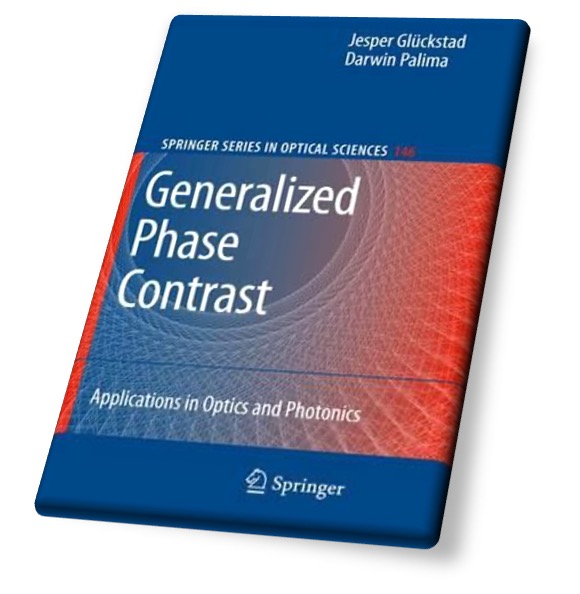
Questions?
Whether you have a question, an idea, or a potential collaboration in mind, don't hesitate to reach out.
Shortcuts
Faculty of Science University of Southern Denmark
- Campusvej 55
- Odense M - DK-5230
- Phone: +45 6550 1232
Last Updated 10.07.2026