Projects
Hearing in marine mammals, and how it is affected by noise
We use psychophysical and electrophysiological techniques to quantify the hearing abilities of trained marine mammals. We also quantify how their hearing functions during active echolocation.
Hearing in moving odontocetes. By attaching an archival tag to the back of a porpoise or dolphin, we can derive data on their hearing abilities while actively swimming through the water and echolocating. Funded by the Office of Naval Research and SDU Climate Cluster.
Echolocation in wild and trained odontocetes
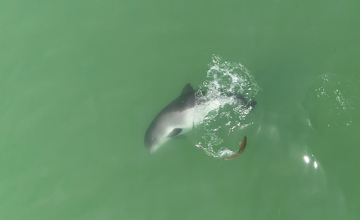
We study how echolocation is performing in trained species using different types of echolocation signals. We also study echolocation behaviour in wild specimen using drones and hydrophone arrays and archival tags. Our studies are founded by our Carlsberg Foundation Semper Ardens center.
Cylinder wall thickness discrimination in dolphins and porpoises.
Ontogeny of echolocation in toothed whales.

Effects of human disturbances on porpoises
Effects of human disturbances on porpoises. Harbour porpoises are vulnerable to human activities. Animals are bycaught in gill nets, are disturbed by intensive underwater noise from e.g., construction work at sea, and their prey species is vulnerable to habitat loss. We investigate the reactions to noise of animals kept in captivity and in the field (using drones).
Temporary threshold shifts in porpoises due to vibropiling noise. We investigate temporary changes in the hearing abilities of porpoise when exposed to noise from windfarm construction work using so-called vibropiling techniques. Funded by WOZEP, Netherlands.
Harbour porpoise reactions to Passive Nature Restauration of Marine Habitats (PReMah), more specifically how porpoise react to the large ban of bottom trawling soon to be implemented in inner Danish waters. Funded under Green Programme: Green transition of fisheries and aquaculture.
Contact
If you have further questions or any inquiries, please do not hesitate to reach out.