Can Immersive Theatre Experience Shift Environmental Policy Preferences?
Researchers from the University of Southern Denmark and the University of Stavanger, working together with the Danish theatre company Secret Hotel, are investigating whether an immersive theatre performance shifts public support for nature-based coastal protection, comparing survey responses before and after the show. Findings will support policymakers in designing better public engagement for climate adaptation.
As part of the ARE BEST NbS project, researchers from the University of Southern Denmark and the University of Stavanger, in collaboration with the Danish performing arts company, Secret Hotel, are investigating whether an immersive theatre performance can influence public preferences for nature-based coastal protection.
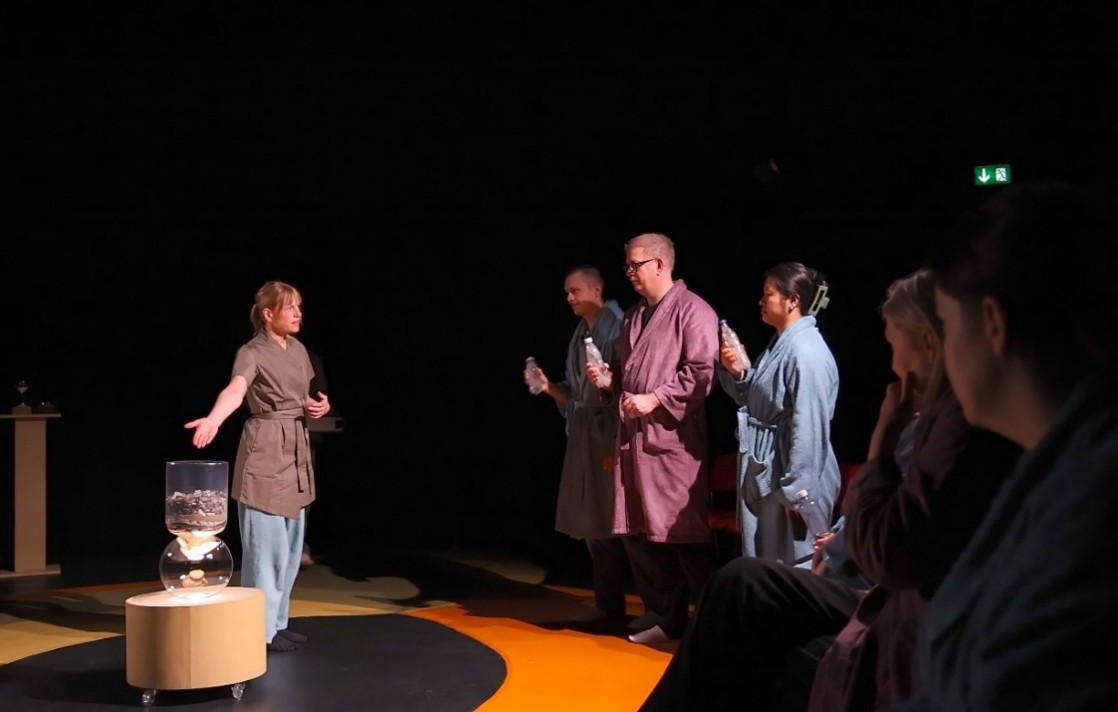
The experiment is based on Secret Hotel’s immersive and participatory performance Spillet om H₂O (The H₂O Game), which was presented in three major Danish coastal cities: Copenhagen, Aarhus, and Kolding. The performance was centred on water, including its different forms, people’s experiences and relationships with it, how it becomes polluted, and how it can be purified. An equivalent experiment will also be conducted in Hungary and Portugal, enabling researchers to examine the relationship between immersive performance and public preferences across different national contexts.
Audience members completed a one-time survey, either before or after attending the performance, rating two hypothetical coastal protection scenarios (varying in flood risk reduction and cost). For each scenario, they indicated their level of policy support, how they would vote in a hypothetical referendum, and their willingness to pay through an earmarked annual household tax. Comparing the before and after groups allows researchers to investigate whether the immersive experience shifts these attitudes, and whether that shift depends on how much flood protection a scenario offers or what it costs.
These findings provide insight into whether artistic and experiential forms of public engagement can strengthen climate-adaptation communication, offering guidance for policymakers and practitioners on how to design future engagement strategies that build public acceptance of nature-based solutions.