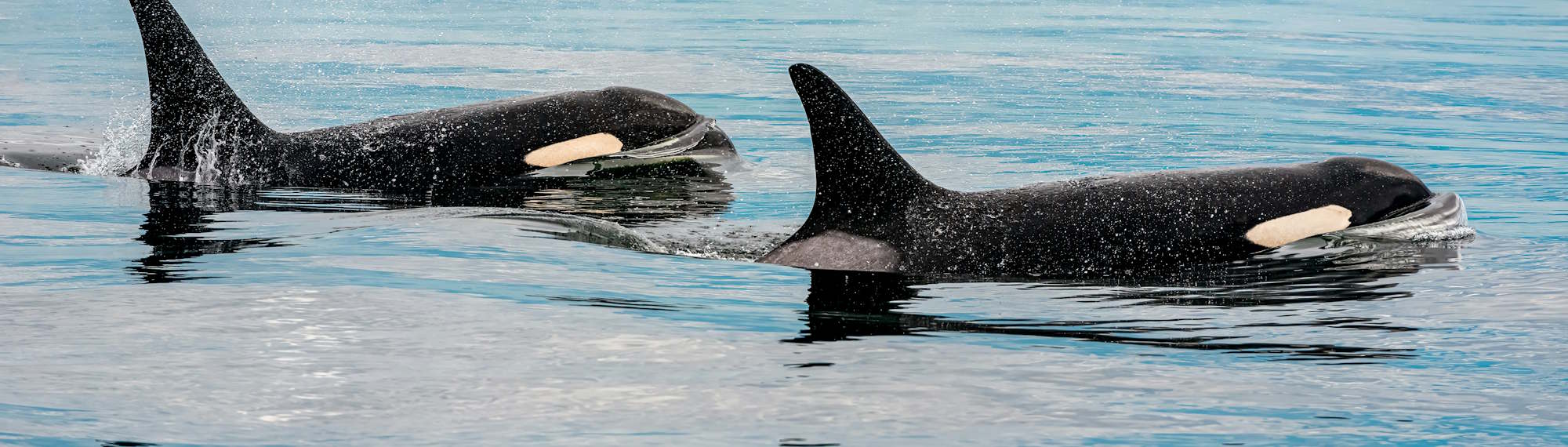
Are These Killer Whales Cannibals? They Probably Don’t Think so Themselves
Two discoveries of torn-off killer whale fins bearing clear tooth marks from conspecifics point toward cannibalism – but according to SDU’s whale researcher, the explanation isn’t quite that simple.
In 2022, a Russian whale researcher made a remarkable discovery on Bering Island off Russia’s Pacific coast: a severed killer whale fin marked with the teeth of another killer whale. In 2024, it happened again. The two finds were two kilometres apart.
When University of Southern Denmark whale researcher Olga Filatova received the photos from the Russian researcher, who is also her longtime collaborator in the region, Sergey Fomin, she had little doubt: a killer whale had sunk its teeth into – and eaten – another killer whale. But whether that should be defined as cannibalism is less certain.
By definition, cannibalism occurs when an animal eats a member of its own species. In the official world of taxonomy, there is only one species of killer whale: Orcinus orca – therefore, the behaviour qualifies as cannibalism.
“But in the real world, killer whales are so different from each other that many researchers argue they should be divided into several subspecies. They live in groups isolated from one another, they don’t socialize across groups, and they don’t interbreed. That’s also true in this case – and the hunting killer whales most likely do not perceive the ones they feed on as belonging to their own species,” explains Olga Filatova, associate professor at the Department of Biology and affiliated with SDU Climate Cluster.
Together with Sergey Fomin and their colleague Ivan Fedutin – who conducts research both at the Department of Biology and at Fjord&Bælt in Kerteminde, Denmark – she has published a scientific article describing the two fins and discussing what the discoveries can tell us.
The article is published in Marine Mammal Science and is available here.
Unlikely it was "just" a fight
The researchers cannot rule out the possibility that the fins came from carcasses and that the animals had died from other causes before being eaten. But since dead killer whales usually sink very quickly and become inaccessible, active hunting is the more likely explanation.
They also consider it unlikely that the injuries were from “mere” aggression. Hunting killer whales always eat the animals they kill, typically leaving behind only a few low‑energy parts, such as fins.
"Also, if it was just aggression, they wouldn’t bother to tear off the fin", says Olga Filatova.
They also hunt seals, sea lions, porpoises and other whales
In the area where the fins were found, resident groups of killer whales live. These groups feed on fish and are characterized by an exceptionally strong family structure. Each family is led by a female and may include up to four generations of descendants. Both sons and daughters remain with their mother’s group for life, leaving only for a few hours to mate before returning.
The waters are also home to transient groups. These live in smaller, looser social units and hunt other marine mammals such as seals, sea lions, porpoises and other whales.
Although the two types of killer whales live in the same area and – at least taxonomically – belong to the same species, they never mix.
“They almost certainly do not perceive themselves as belonging to the same species. For the transient groups, the resident killer whales are simply prey,” says Olga Filatova.
Fatal outcome
For the residents, the consequences of this perception are bloody and sometimes fatal.
“Most likely, this predation pressure forced them to develop their unique, tight-knit family structure, where they protect each other and thus increase their chances of survival,” she explains.
It may have been hundreds of thousands of years since residents and transients first encountered each other near Bering Island and the need for strong families emerged. The first transients arrived from the Atlantic when the waters became ice-free and colonized the area. They were already there when the residents later found their way into the area. By then, the transients were already specialized predators of marine mammals.
Killer whale facts
- After humans, killer whales are the most widely distributed mammal on Earth. They occur in all the world’s oceans.
- Researchers believe there may be up to 20 different subspecies, known as ecotypes.
- In Denmark, they are occasionally seen in the northern Skagerrak and the North Sea. A trip to Skagen offers the best chance of spotting killer whales when they pass by in May.
“We are witnessing an evolutionary process: these two groups, which never mix, are becoming increasingly distinct. At some point, they will be so different that they will become separate species,” says Olga Filatova.
It’s not just these two groups that may deserve their own subspecies names. Around the world, killer whales differ greatly: some feed almost exclusively on minke whales, others mainly on seals, Antarctic toothfish, tuna, penguins, or sharks. Some live along coasts, others exclusively in open waters, while others have no fixed habitat at all.
Off Bering Island, resident family members occasionally disperse for an hour or two and seek contact with other resident families before returning to their families. Multiple families may gather in large assemblies, especially to provide opportunities for young females and males to mate outside their own family. These gatherings can span several square kilometres. During such events, family members are farther apart than usual – increasing the risk posed by hunting killer whales.
One such gathering took place just days before Sergey Fomin discovered one of the severed fins with bite marks.
The research is supported by the Human Frontier Science Program.
Meet the Researcher
Olga Filatova is a whale research and associate professor at Department og Biology and SDU Climate Cluster.