Social inequality in health is one of the greatest challenges the Nordic welfare states are facing. Although the healthcare system is based on the principle of equal access for all, differences in people’s health remain significant – and are growing. Equal access does not necessarily lead to equal outcomes. That is why the research project “ULIG: Humanistic contributions to health equity” is investigating how inequality arises and is experienced in the interaction between people, technology and institutions
How does inequality manifest itself in everyday life?
Health inequalities are not just about income, education or labour market participation. It is also created in the many everyday interactions with the healthcare system, where waiting times, digital self-service, patient portals, language barriers and social norms can affect people’s ability to access help and achieve good health.
Gender is an important and complex factor in health inequalities. Another factor affecting people’s health is their ability to utilise and navigate healthcare services, which requires digital skills. Furthermore, people’s linguistic and cultural backgrounds play a role in how they benefit from health communication.
The project therefore examines questions such as:
How is inequality experienced as a physical, emotional and social experience?
How does inequality arise in interactions between citizens and the healthcare system?
How do digitalisation, documentation requirements and self-monitoring affect different groups?
How can health communication be developed so that more people feel understood and included?
The humanities as the key to greater equality
The ULIG project takes a humanistic and practical approach to health and investigates the processes through which health, care and responsibility are negotiated in everyday life. The project combines literary studies, sociolinguistics, philosophy, cultural analysis and ethnography to understand how people navigate the demands and expectations of the healthcare system.
The researchers are particularly interested in identifying methods and tools for more socially conscious health communication and in creating a conceptual framework for understanding and addressing inequality and promoting equity across sectors.
The project’s two main strands
Everyday contact zones – body, time and language
Through ethnographic studies, linguistic analyses and investigations of patient portals and self-monitoring, we examine how waiting times, digital solutions, communication and the demands of everyday life can create barriers for certain groups. The aim is to understand the processes through which access, resistance, strain and scope for action are shaped, and how inequality gradually arises in the interplay between body, time, language and technology.
Narratives, equity and new formats
The project’s second strand investigates how inequality is represented and understood in society. The researchers analyse narratives about illness, health and social class, and develop proposals for more socially equitable forms of communication. Through analyses, user tests and design workshops, new digital and analogue formats are being developed to reduce language barriers and facilitate better interactions between citizens and the healthcare system.
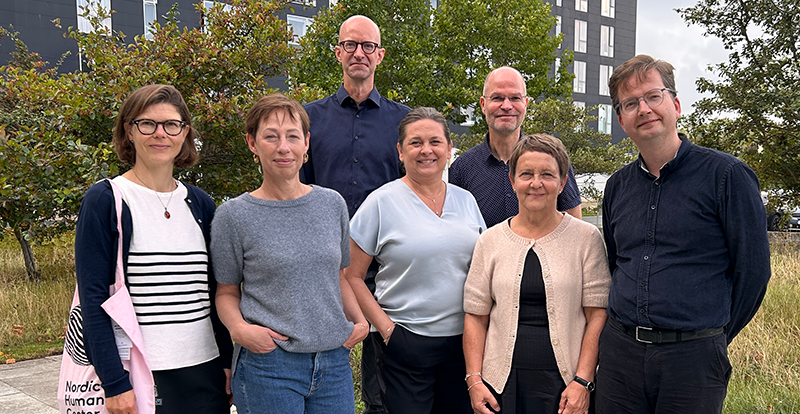
Researchers in the ULIG project: Humanities contributions to health equity
- Associate Professor Anders Juhl Rasmussen (Co-PI, University of Copenhagen, Department of Nordic Studies and Linguistics)
- Professor Karen Hvidtfeldt (Co-PI, University of Southern Denmark, Department of Culture and Language)
- Associate Professor Anette Grønning (University of Southern Denmark, Department of Design, Media and Educational Science)
- Professor Astrid Pernille Jespersen (University of Copenhagen, Saxo Institute)
- Professor Martha Sif Karrebæk (University of Copenhagen, Department of Nordic Studies and Linguistics)
- Professor Søren Harnow Klausen (University of Southern Denmark, Department of Design, Media and Educational Science)
Exchange of knowledge
The group of fellows collaborates and exchanges knowledge with researchers from Aarhus University and with researchers from Sweden, Norway and the USA. In addition, organisations with practical experience are involved, contributing a user perspective, case studies and professional feedback.